
- All
- Product Name
- Product Keyword
- Product Model
- Product Summary
- Product Description
- Multi Field Search
 English
Views: 0 Author: Site Editor Publish Time: 2026-10-02 Origin: Site


Material selection in fluid transfer systems requires precise attention. Using the wrong rubber for fuel lines goes beyond simple inefficiency. It creates a severe safety hazard. Misapplication remains a primary cause of catastrophic system failure in automotive and industrial machinery. You must evaluate chemical interactions carefully. Many mechanics and engineers ask about specific elastomers. Ethylene Propylene Diene Monomer (EPDM) is highly popular across many industries. However, we must state this clearly. EPDM is fundamentally incompatible with petroleum-based fuels. Gasoline and diesel destroy this material rapidly. This guide explains the complex chemical realities driving this incompatibility. We outline the severe risks associated when misusing these materials. Finally, we provide a reliable framework to help you select safe, industry-standard fuel-grade hoses for your exact operating parameters.
Zero Compatibility: EPDM rubber cannot be used for gasoline, diesel, or petroleum-based oils; it will rapidly degrade, swell, and fail.
The Science of Failure: Petroleum fuels cause EPDM polymers to break down, leading to fuel contamination, leaks, and potential fire hazards.
Common Pitfalls: A frequent and dangerous mistake is repurposing EPDM coolant or heater hoses for fuel transfer applications.
Correct Alternatives: Nitrile (NBR), Viton (FKM), PTFE, and ECO are the industry-standard materials required for safe fuel transfer.
Ethanol Variables: Modern ethanol-blended fuels (E10, E85) require specific material evaluations beyond basic petroleum resistance.
The definitive answer is no. When asking can EPDM hose be used for fuel, you must understand the immediate danger. You cannot use EPDM for any petroleum-based fuels. It will fail. The chemical makeup of the rubber guarantees this outcome.
Chemistry relies on a basic rule. Like dissolves like. Both EPDM and petroleum fuels operate as non-polar hydrocarbons. They share similar molecular structures. When they interact, the non-polar fuel permeates the non-polar EPDM polymer matrix. The fuel acts as a highly aggressive solvent. It physically pulls the polymer chains apart. This interaction causes the rubber to dissolve from the inside out. EPDM possesses no chemical defense against petroleum molecules.
EPDM remains an incredible engineering material when used correctly. Manufacturers design it specifically for polar fluids and harsh environmental conditions. You will find it excelling in automotive cooling systems. It handles engine coolant and water perfectly. It resists steam and brake fluids without degrading. Furthermore, EPDM offers outstanding resistance to ozone, UV rays, and extreme weather exposure. If a system moves water, air, or glycol, EPDM often serves as the best choice. Keep it strictly away from oil and fuel.
Mistakenly installing an EPDM hose in a fuel system creates immediate problems. The degradation process begins the moment fluid touches the rubber. We see a predictable and dangerous sequence of failure.
The failure follows three distinct stages.
Stage 1: Swelling and Softening. The hose absorbs the fuel like a sponge. It balloons in size quickly. The rubber turns incredibly soft. It loses all structural tensile strength. You can easily pinch the hose shut using just two fingers.
Stage 2: Leaching and Contamination. The rubber compounds break down into a black, sticky sludge. The moving fuel carries this debris downstream. It clogs fuel filters instantly. It jams delicate fuel injectors and ruins carburetors. Your engine will suffer severe drivability issues before stopping entirely.
Stage 3: Catastrophic Rupture. The weakened hose cannot hold internal pressure. Modern fuel pumps push fluid at high velocities. Pressurized systems inevitably blow out the compromised rubber. This blowout sprays highly flammable fuel directly onto hot engine exhaust components. A massive fire hazard results.
We must call out a common and dangerous practice. Many people grab a generic radiator heater hose to replace a broken fuel line during emergencies. Heater hoses look identical to fuel hoses on the outside. They have a black rubber jacket. They bend easily. However, heater hoses consist primarily of EPDM. Repurposing them for fuel guarantees a sudden breakdown. Never use a coolant hose to move gasoline, even temporarily to get a vehicle home.
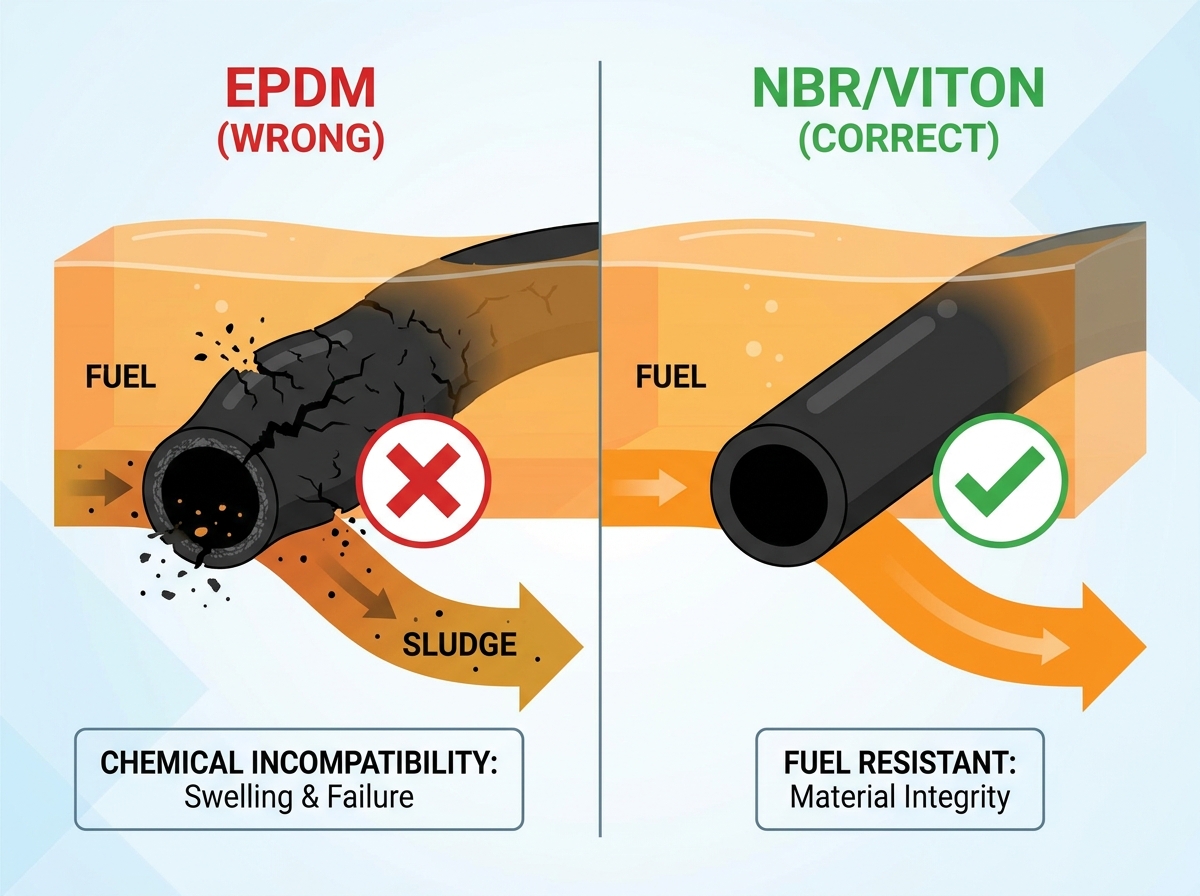
Since EPDM fails, you must identify proper solutions. Selecting the correct fuel transfer hose material ensures system longevity and user safety. The industry relies on four primary compounds.
Fuel Hose Material Comparison
Material Type | Primary Application | Key Advantage | Primary Limitation |
|---|---|---|---|
Nitrile (NBR) | Standard Gas/Diesel | Cost-effective petroleum resistance | Lower high-heat tolerance |
Viton (FKM) | Aggressive Fuels/High Heat | Extreme chemical resistance | Higher acquisition cost |
PTFE (Teflon) | Racing/High Pressure | Chemically inert | Requires specific fittings |
Epichlorohydrin (ECO) | Modern Automotive OEM | Low permeation rates | Complex manufacturing |
Nitrile serves as the global industry standard for basic gasoline and diesel applications. It handles petroleum hydrocarbons exceptionally well. Pros include robust petroleum resistance and high cost-effectiveness. You will find NBR in millions of standard passenger vehicles. Cons include a lower heat tolerance compared to premium alternatives. It can harden over time if exposed to extreme under-hood temperatures.
Viton represents the upgrade choice. Engineers specify FKM for demanding environments. Pros include superior resistance to high ambient heat. It handles aggressive modern fuels effortlessly. It resists chemical degradation better than standard NBR. Manufacturers often use FKM as a thin inner liner inside multi-layer premium hoses. This provides exceptional chemical defense while keeping costs manageable.
PTFE dominates the high-performance and racing sectors. Pros include absolute chemical inertness. It reacts to virtually no fuels, additives, or alcohols. Manufacturers usually wrap PTFE liners in a stainless-steel braided jacket. This combination handles extreme internal pressures easily. It also eliminates vapor permeation, removing fuel smells entirely from enclosed spaces.
ECO sees heavy usage in modern Original Equipment Manufacturer (OEM) automotive applications. It balances fuel resistance and impressive low-permeation characteristics. Environmental protection agencies require strict emission controls. ECO prevents fuel vapors from escaping through the hose walls into the atmosphere.
The modern fuel landscape complicates material choices. Basic EPDM fuel hose compatibility remains a non-starter. However, even correct petroleum hoses can struggle today. Modern fuels contain high amounts of ethanol.
Ethanol acts as an intense, drying solvent. Traditional older NBR formulations struggle under constant alcohol exposure. The ethanol strips the essential plasticizers out of the rubber compound. The hose dries out internally. It becomes brittle and cracks. These micro-cracks lead to slow, dangerous leaks. E85 contains up to 85% ethanol. This concentration destroys standard rubber lines very quickly.
If your system runs E85 or flex-fuels, shift your decision criteria. Standard NBR will not survive long term. You must upgrade your material choices. We recommend shifting to PTFE inner liners. Alternatively, choose specialized multi-layer FKM hoses. Manufacturers design these specifically for high-alcohol environments. They resist the drying effect of ethanol completely.
Selecting the right product requires a methodical approach. Follow this authoritative checklist when sourcing fuel lines. Do not guess based on appearance.
Fluid Chemistry: Identify the exact liquid. Is it pure diesel, standard E10 gasoline, biodiesel, or a heavy ethanol blend? Each requires a specific inner tube compound.
Operating Pressure: Determine your system pressure. Older carbureted systems operate at low pressure, usually 5 to 7 psi. Modern Electronic Fuel Injection (EFI) systems require high pressure. They often exceed 60 psi. EFI systems demand reinforced hoses designed to prevent bursting.
Temperature Environment: Evaluate ambient heat. Under-hood engine temperatures spike high. Measure the actual fluid temperatures. Ensure the hose jacket compound withstands these thermal loads.
Permeation Standards: Review compliance requirements. The EPA and CARB enforce strict low-permeation regulations. Your hose must trap fuel vapors internally to meet these legal environmental standards.
You must look for specific Society of Automotive Engineers (SAE) ratings. Do not judge a hose by the material name alone. SAE ratings guarantee performance metrics.
Look for SAE J30R9 for standard EFI systems. It handles high pressure and moderate ethanol blends.
Look for SAE J30R12 for advanced low-permeation requirements.
Look for SAE J30R14 for ultra-low permeation applications.
The rating appears printed directly on the outer jacket of the hose. If you cannot find an SAE rating, do not use it for fuel.
We must reiterate the severe danger of using EPDM for fuel applications. EPDM dissolves rapidly when exposed to gasoline or diesel. Cutting corners compromises safety completely. It guarantees catastrophic system failure. You risk engine damage, fires, and physical harm.
You should take immediate action based on these facts. First, audit your current fluid transfer systems. Second, check the SAE printed codes on your existing hoses. Confirm they carry proper fuel ratings. Third, consult with a certified hose manufacturer or distributor. They will help you specify the exact NBR, FKM, or PTFE solution required for your operating parameters. Do not leave material compatibility to chance.
A: No. Pure biodiesels can act differently than traditional petroleum diesel. However, EPDM remains highly unrecommended. Biodiesel blends vary wildly in chemical composition. EPDM still carries a massive risk of severe degradation, swelling, and eventual system failure when exposed to biodiesel variants.
A: Visual inspection is completely unreliable. Both appear as black rubber tubes. You must look for printed laylines or SAE specifications on the hose jacket. If the origin is unknown, perform a simple solvent test. Soak a scrap piece in gasoline. EPDM will swell and soften rapidly, while Nitrile remains stable.
A: No. Engine oil derives from petroleum bases. It acts similarly to fuel. The oil permeates the non-polar EPDM structure. This causes the rubber to swell, lose tensile strength, and degrade into sludge. You must use Nitrile or FKM for engine oil applications.