
- All
- Product Name
- Product Keyword
- Product Model
- Product Summary
- Product Description
- Multi Field Search
 English
Views: 0 Author: Site Editor Publish Time: 2026-10-12 Origin: Site


Misunderstanding fire hose testing terminology leads to severe compliance failures. It voids warranties and creates immense liability risks if equipment fails during an emergency. Facility managers, fire chiefs, and procurement officers face a critical challenge. You must distinguish between manufacturer-level destructive testing and routine field-level compliance testing. Getting this distinction wrong means procuring incorrect validation services. It endangers your personnel and exposes your organization to legal action.
This guide establishes the operational and legal differences between these testing methods. We align them directly with NFPA 1962 requirements. You will learn exactly how to interpret these standards for your daily operations. Finally, we provide a clear framework for evaluating in-house against third-party testing solutions. You can use this knowledge to secure the right vendors and protect your teams.
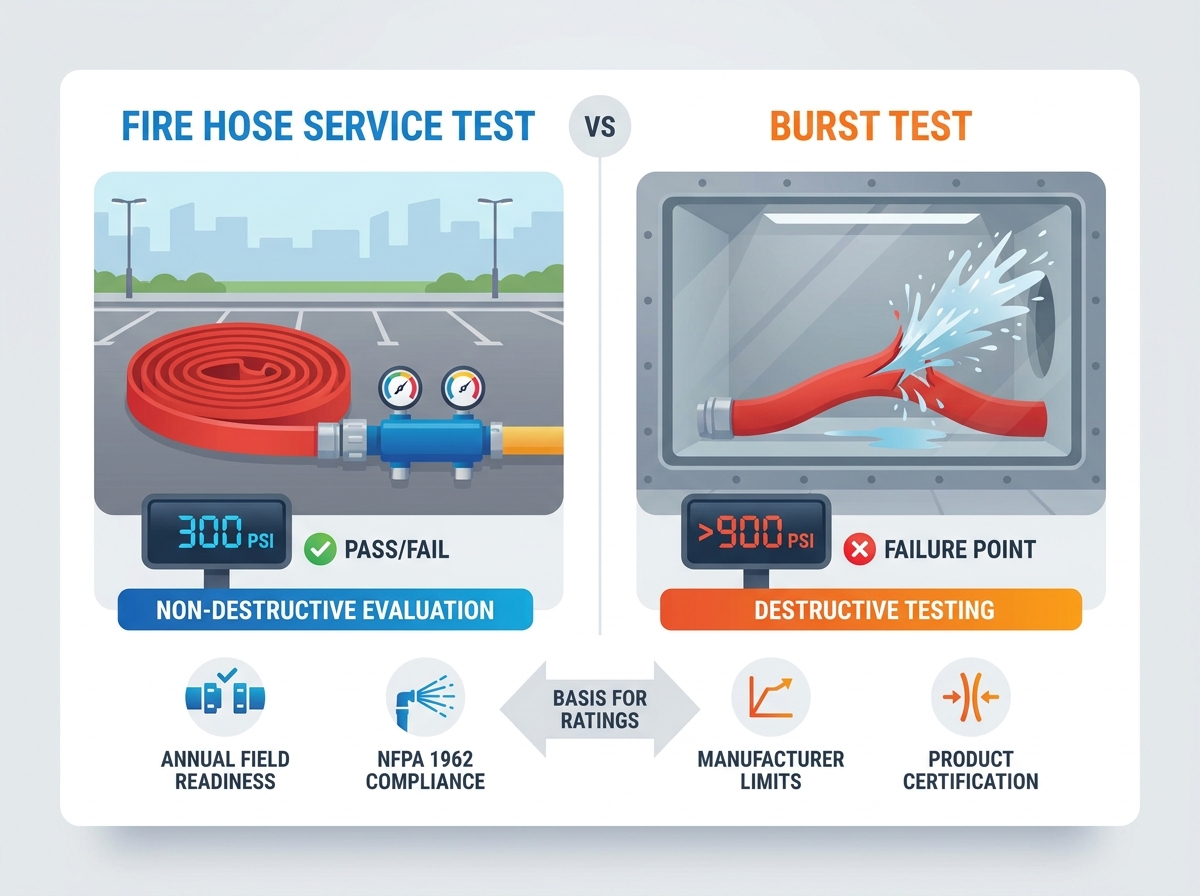
A fire hose service test is an annual, non-destructive evaluation to verify ongoing field readiness and NFPA 1962 compliance.
A burst test is a destructive, manufacturer-level procedure used to determine the absolute failure point of a hose design.
Service test pressures are mathematically derived from the hose’s original acceptance or burst ratings; they are not interchangeable metrics.
Outsourcing the fire hose hydrostatic test to third-party vendors often mitigates in-house liability and ensures standardized drying and documentation processes.
Operating without documented, standardized testing exposes organizations to massive negligence claims. Precision in terminology dictates the exact service you request from third-party vendors. If you ask a vendor for the wrong test, you waste budget and risk catastrophic equipment failure. Safety relies entirely on accurate language and proper execution.
Many departments assume visual inspections cover their legal obligations. They do not. Courts often look directly at NFPA standards during injury lawsuits. Failing to conduct proper evaluations leaves a glaring liability gap. If a hose bursts on the fireground, investigators will demand your annual logs. Lacking these records proves negligence. You must secure clear documentation for every single asset in your inventory.
You need to understand two completely different engineering concepts. Service testing serves as an evaluation. It assesses the current condition of the equipment. It determines ongoing lifecycle viability. Conversely, burst testing acts as a validation. Engineers use it to validate material limits during initial production. Validation happens once at the factory. Evaluation happens annually in the field. Mixing up these concepts leads to dangerous procurement errors.
NFPA 1962 governs the care, use, and service testing of fire hoses. It mandates the exact frequency and methodology for these evaluations. It strictly dictates how you must record service tests. However, NFPA 1962 does not mandate burst testing for end-users. Manufacturers handle burst protocols under different manufacturing standards. You only need to focus on compliance evaluation.
Best Practice: Always maintain digital compliance logs. Cloud-based records protect you during unexpected safety audits.
Common Mistake: Assuming a high factory rating means you can skip annual field evaluations. High ratings do not stop field wear and tear.
Field readiness ensures your team can deploy equipment confidently. The primary purpose of this evaluation involves non-destructive stress application. You want to ensure the hose safely handles standard operational pressures. It must not fail or leak during an emergency response.
Inspectors look for three critical points of potential failure. First, they monitor coupling integrity. They watch for slippage between the hose and the metal coupling. Second, they evaluate the jacket and lining. Technicians inspect for weeping, bulges, or separation under active pressure. Finally, they assess valve and gasket condition. Pre-test visual inspections of threads and rubber seals prevent blowout hazards.
The fire hose hydrostatic test mechanism requires strict adherence to safety protocols. You must execute several distinct steps precisely. Errors here cause severe injuries.
Layout the hose in straight lines across a flat staging area.
Connect lines to a specialized testing manifold equipped with safety check valves.
Fill the entire length slowly using water.
Bleed all trapped air from the system. This step remains absolutely crucial for operator safety.
Raise the system to the specified service test pressure. You usually find this number stenciled directly on the outer jacket.
Hold this exact pressure for a strict duration, typically 3 minutes.
Gradually release pressure and disconnect all hardware.
Bleeding air prevents violent explosions. Water does not compress easily. Air compresses highly. If a jacket tears while holding compressed air, it releases explosive energy. Water merely spills harmlessly upon structural failure.
A successful test remains incomplete without proper aftercare. You must dry the equipment thoroughly. Many departments utilize vertical hose towers or specialized commercial dryers. Repacking wet equipment guarantees mildew growth and rapid rubber degradation. This ruins the lining long before the next annual evaluation.
Engineers design equipment to survive extreme conditions. To guarantee this survival, they must know exactly when the equipment dies. The burst test fulfills this destructive purpose. Manufacturers conduct it on sample batches at the factory. They identify the exact threshold of catastrophic failure in a controlled laboratory.
Laboratory technicians monitor specific material breaking points. They measure material yield first. They record the specific PSI at which the synthetic or cotton jacket physically tears apart. Next, they test adhesion limits. They pinpoint the exact moment the internal rubber or polyurethane lining completely separates from the outer protective jacket. Both metrics dictate overall safety margins.
The fire hose burst pressure metric serves as the mathematical foundation for all other ratings. It dictates acceptance ratings and annual requirements. For example, acceptance test pressure often sits at a specific fraction of the established burst rating. Service requirements drop even lower to ensure non-destructive safety.
End-users should never attempt a burst protocol. Doing so destroys valuable inventory. More importantly, it endangers everyone nearby. Procurement teams use burst ratings strictly as purchasing specifications. You review these numbers to gauge durability margins against your typical operational pressures.
Best Practice: Specify minimum burst ratings in your procurement contracts to ensure high-quality manufacturing standards.
Common Mistake: Misinterpreting the factory burst rating as a safe operating limit for daily pump operations.
Understanding the exact differences between these methods prevents operational confusion. They require entirely different environments, pressures, and documentation outcomes. We outline these varying parameters below to clarify your operational responsibilities.
Table 1: Operational Differences Between Testing Methods
Parameter | Service Evaluation | Burst Validation |
|---|---|---|
Testing Environment | Conducted on-site. Uses parking lots or staging areas. Relies on portable specialized manifolds. | Conducted in controlled facilities. Uses heavily shielded manufacturing laboratory environments. |
Pressure Application | Capped at the stenciled service limit (e.g., 250 to 400 PSI). Varies by type and standard. | Continually increased until the unit physically ruptures. Often exceeds 900+ PSI. |
Primary Objective | Verify current field readiness and detect physical degradation. | Prove engineering margins and validate material strength during production. |
Outcome & Documentation | Yields a Pass/Fail log for compliance audits. Failed units undergo repair or removal. | Yields a statistical data point. Used for product certification (e.g., UL or FM approval). |
Service evaluations happen where you work. You utilize open staging areas. You must secure the perimeter to keep bystanders safe. Burst validations happen behind thick blast glass. The factory environments capture explosive kinetic energy safely. Pressure caps keep field evaluations non-destructive. Laboratory pressures deliberately seek destruction to gather empirical data.
Deciding how to execute your annual requirements demands careful thought. Many organizations default to internal execution to save upfront budget. However, this often introduces severe hidden risks. You must evaluate the operational drag and liability exposure.
Conducting a compliant fire hose service test vs burst test evaluation internally requires significant resources. It drains massive labor hours from your operational staff. You need specialized hydrostatic testing pumps to do it safely. Furthermore, your organization assumes all liability for personnel safety. If a heavy metal coupling becomes a projectile due to user error, the resulting injuries fall squarely on your shoulders.
Outsourcing pushes the liability onto specialized experts. However, you must vet these vendors rigorously. Use the following criteria to shortlist reliable partners.
Equipment Safety: Do they use engineered testing manifolds equipped with safety check valves? Or do they dangerously use a standard fire apparatus pump? Apparatus pumps cause pressure spikes and lack adequate safety bleeds.
Documentation Standards: Do they provide cloud-based, audit-ready compliance logs? These logs must map directly to individual serial numbers or barcodes.
Post-Test Care (SLA): What is their service level agreement for drying and rolling? How quickly do they return inventory to operational status?
You must weigh the hard costs of a third-party vendor against hidden operational burdens. Internal execution seems cheap until you calculate firefighter or staff downtime. You must also factor in workers' compensation risks. Finally, consider the legal costs of a potential audit failure due to messy internal paperwork. Paying a specialized vendor often delivers a vastly superior safety outcome. It provides peace of mind and bulletproof compliance documentation.
Best Practice: Ask prospective vendors for a sample compliance report before signing any contracts.
Common Mistake: Using your frontline pumper truck to pressurize lines. This damages expensive apparatus pumps and bypasses crucial safety valves.
Your team depends on reliable equipment during critical emergencies. Routine evaluations keep your current inventory legally compliant and safe for daily use. Conversely, factory validations serve as manufacturer benchmarks. They inform your initial purchasing decisions but play no role in your annual maintenance.
Take immediate action to secure your operational readiness. First, audit your current inventory logs for missing or expired service dates. Second, identify any units lacking proper barcode or serial tracking. Finally, if your internal resources feel stretched, begin evaluating third-party hydrostatic vendors. Choose partners who guarantee NFPA 1962 compliance and provide full lifecycle documentation. Doing so protects your budget, your liability, and your personnel.
A: According to NFPA 1962, in-service fire hoses must be hydrostatically tested at least once annually. You must also perform this evaluation immediately after any repairs or instances of suspected damage.
A: The hose must be immediately removed from active service. Depending on the failure type, you may repair it. For example, a leaking coupling can be recoupled. If the jacket bursts, you must permanently condemn and destroy the unit.
A: No. Burst testing is strictly a destructive manufacturing procedure. Attempting to reach burst pressure in the field poses severe fatal risks to personnel. It requires heavy shielding and specialized laboratory equipment.
A: It uses water. Using compressed air is highly dangerous and explicitly forbidden by industry standards. Compressed air expands violently upon a structural failure, turning couplings and debris into deadly projectiles.