
- All
- Product Name
- Product Keyword
- Product Model
- Product Summary
- Product Description
- Multi Field Search
 English
Views: 0 Author: Site Editor Publish Time: 2026-10-05 Origin: Site


Fluid transfer relies heavily on uninterrupted structural integrity. When high-pressure lines rupture in the field, entire operations grind to an immediate, expensive halt. Premature hose failure rarely happens uniformly across the entire structure. Instead, it typically isolates at either the internal lining or the outer cover. Abrasive fluids heavily degrade the interior. Conversely, harsh environmental drag destroys the exterior. Misdiagnosing this primary wear vector leads to over-specifying expensive materials. You also risk frequent replacement downtimes. This article dissects how these dynamic layers actually work. We compare the specific wear mechanisms the inner lining and the outer jacket must withstand. By understanding these differences, procurement and engineering teams can confidently specify correct layer thicknesses. You will learn to match material blends directly to your most severe operational hazards. Armed with this knowledge, you can extend equipment lifespans significantly.
The internal TPU lining is engineered for hydrodynamic smoothness and particulate abrasion resistance, protecting against internal blowouts from slurries or frac sand.
The outer cover is formulated for mechanical drag, puncture resistance, and environmental degradation (UV/Ozone), often requiring different shore hardness than the lining.
Specifying a high-spec lining is useless if external dragging destroys the cover, and vice versa. Balanced layer specification requires mapping the primary operational hazard.
Through-the-weave extrusion methods blend lining and cover performance, but independent dual-layer constructions offer specialized wear profiles for extreme environments.
Industrial hoses operate as active pressure vessels. They face two distinct hostile environments simultaneously. The internal payload constantly batters the inside. Meanwhile, the external terrain attacks the outside. We must treat these two fronts independently during specification.
Manufacturers use different methods for polyurethane hose construction. First, independent layer assembly glues or vulcanizes a separate lining to a woven jacket. This offers customized material selection for each side. Second, extruded "through-the-weave" construction pushes molten polymer through a circular woven textile. The textile matrix usually consists of high-tenacity polyester or polyamide yarns. This woven core provides the burst strength required for high-pressure applications. The lining and cover form one monolithic structure around the matrix. This eliminates delamination risks.
Why choose Thermoplastic Polyurethane (TPU) over traditional rubber or PVC? TPU sets a superior material baseline. It provides exceptional tensile strength. It also resists physical cuts far better than standard nitrile rubber. You get a lighter hose profile without sacrificing structural safety. Polyurethane stretches and recovers efficiently under dynamic pressure spikes.
Let us analyze the internal wear mechanisms. High-velocity fluids relentlessly erode hoses from the inside out. Suspended solids act like liquid sandpaper. Fracking operations pump coarse silica sand. Dewatering operations move heavy sludge. Corrosive chemicals also strip away molecular bonds over time.
Extruded layers excel here. Optimal TPU liner abrasion resistance comes from extreme surface smoothness. Laminar flow relies on a frictionless boundary layer. When interior walls feature microscopic bumps, turbulence increases. Pumping stations must work significantly harder to maintain volume metrics. A highly extruded, ultra-smooth TPU lining preserves laminar flow perfectly. A smooth interior minimizes friction loss drastically. Fluid moves faster. You lower pump energy requirements significantly. Simultaneously, the slick surface resists micro-abrasions. Particles bounce off rather than gouging the polymer.
We must also consider chemical and hydrolysis factors. TPU handles oil, grease, and many hydrocarbons perfectly. However, prolonged exposure to highly acidic water degrades it. Trapped moisture combined with heat causes hydrolysis. The polymer chains break down internally. Transparency about these limitations ensures you deploy the right hose for the right fluid. Always verify chemical compatibility charts before pumping aggressive solvents.
Common internal wear factors include:
High-velocity liquid friction reducing inner wall thickness.
Suspended abrasive particulates causing micro-gouges.
Chemical solvent degradation weakening polymer chains.
Thermal breakdown from continuously hot fluids.
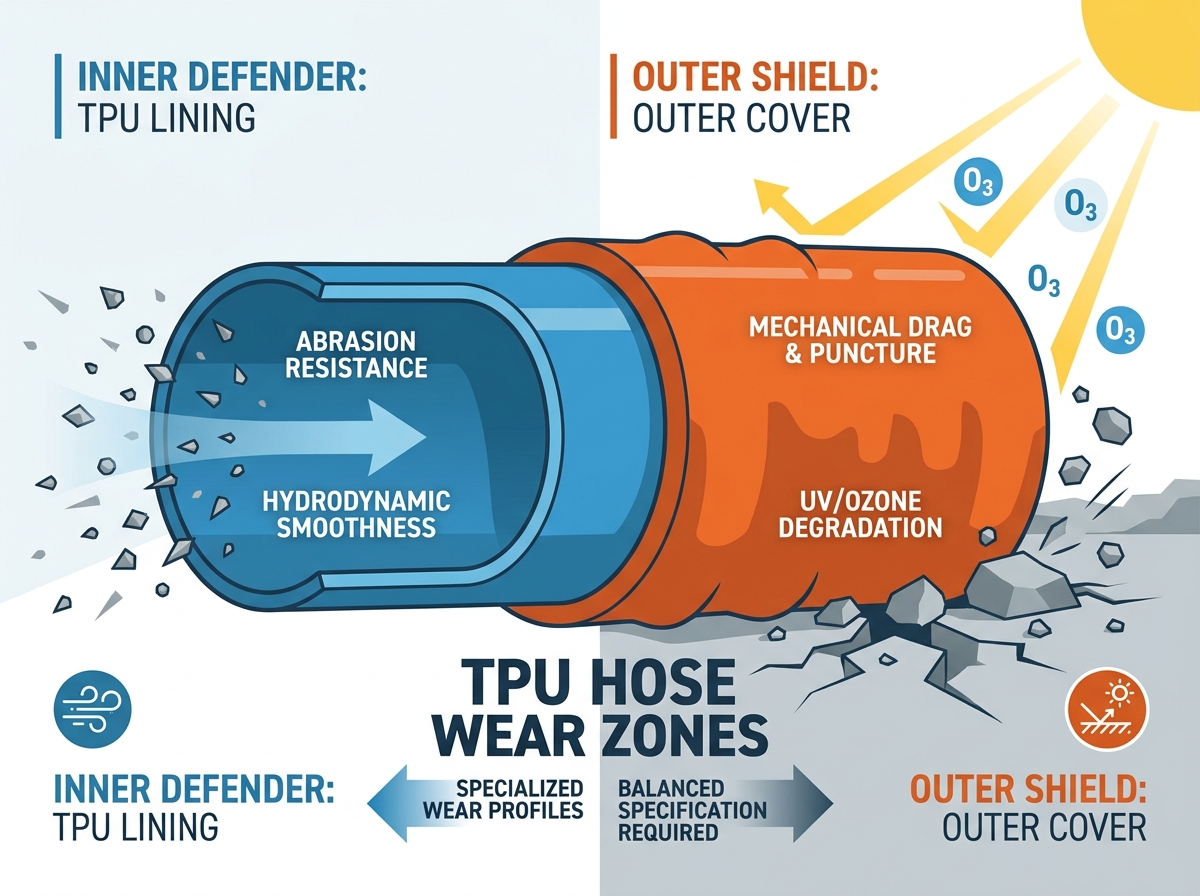
The outer jacket acts as your primary mechanical shield. It survives brutal deployment hazards daily. Crews drag these lines over asphalt, jagged rocks, and construction debris. Puncture threats lurk everywhere. The jacket takes the brunt of this mechanical abuse. A deployment crew might drag an eight-inch frac water line over miles of jagged limestone. A standard jacket will shred within days. Engineers counter this by extruding thicker ribs along the longitudinal axis of the hose.
Environmental degradation presents another silent threat. Ultraviolet radiation attacks exposed polymers. Ozone exposure causes microscopic surface cracking. Extreme temperature fluctuations expand and contract the material. Inferior covers become brittle over time. They crack when bent during winter deployments. High-quality TPU blends incorporate UV inhibitors to prevent this specific decay.
Engineers face a crucial trade-off. Increasing outer thickness directly improves drag resistance. A thicker wall survives longer on rough terrain. However, it significantly increases overall weight. It also enlarges the minimum bend radius. Stiffer hoses resist tight coiling. They complicate deployment in freezing environments. You must balance durability against manual handling logistics.
Evaluating the TPU hose lining vs cover requires direct alignment of material priorities. Liners prioritize maximum flexibility and chemical resistance. You want a softer shore hardness internally. This absorbs particulate impacts better. Polyurethane hardness is measured on the Shore A or Shore D scale. A 75A Shore hardness provides excellent flexibility for a liner. However, an outer jacket might require a 90A Shore hardness to deflect sharp rocks effectively. A harder exterior resists sharp gouges and deep cuts.
Visual inspection reveals distinct failure modes. Internal failures show up as blistering. You might see localized delamination or bulging on the exterior surface caused by internal pressure leaks. External failures are more obvious. You will spot exposed textile matrix yarns. Once the weave shows, catastrophic rupture becomes imminent.
You must map material specifications to your actual field hazards.
Scenario 1: High Internal Abrasion / Low External Drag
Consider stationary transfer lines pumping slurry. The hose never moves once deployed. Here, you prioritize a thicker, specialized TPU lining. A standard, thinner outer jacket suffices perfectly.
Scenario 2: Low Internal Abrasion / High External Drag
Consider agricultural irrigation or wildland fire hoses. They pump clean water but endure constant dragging across fields. You prioritize reinforced, ribbed outer covers. A standard inner lining handles the clean water easily.
Hose Layer Resistance Characteristics
Performance Metric | Internal Lining Focus | Outer Cover Focus |
|---|---|---|
Primary Hazard | Fluid friction and suspended solids | Ground drag and sharp debris |
Ideal Hardness | Lower (Flexible and resilient) | Higher (Rigid and cut-resistant) |
Chemical Threat | Hydrocarbons and acidic fluids | Ozone and UV radiation |
Failure Indicator | Internal blistering or bulging | Exposed textile reinforcement |
Delamination remains a severe implementation risk for dual-layer constructions. Extreme thermal cycling stresses the adhesive bonds. Aggressive chemical permeation can also dissolve these bonding agents. The lining then separates from the outer jacket. It wrinkles inward, choking off fluid flow entirely.
Beware of the over-specification trap. Procurement teams often pay premium prices for ultra-thick outer jackets in static applications. If a hose sits stationary in a sunny field, physical abrasion is zero. UV degradation represents the actual primary risk. A thinner jacket formulated with heavy UV stabilizers performs better than a thick, un-stabilized jacket.
Storage and handling practices dictate actual lifespan. You cannot ignore basic maintenance. Improper rolling creases the polymer. Storing hoses while wet encourages mold on non-TPU textile components. Mice and rodents sometimes chew on exposed rubber, though TPU is generally less attractive to pests. Regardless, localized crushing remains the biggest human error. Driving a heavy forklift over an empty hose compromises the internal textile weave permanently. These human errors destroy hoses regardless of your pristine TPU layer specifications.
You must adopt a rigorous shortlisting logic before purchasing. Stop relying purely on generic technical data sheets.
Define Success Criteria: Calculate acceptable operational longevity. Determine your maximum tolerable replacement frequency. Compare the upfront price against the operational downtime penalty. If a premium hose lasts three times longer, higher upfront expenditure is justified.
Perform a Site Audit: Inspect discarded hoses in your maintenance yard. Identify whether historical failures were predominantly internal blowouts or external abrasions. Let physical evidence guide your strategy.
Execute Vendor Interrogation: Demand specific testing data. Ask manufacturers for the specific shore hardness of the outer cover. Request Taber abrasion test results for the internal liner.
Issue a Targeted RFQ: Specify the exact layer thickness priorities based on your audit. Stop asking for generic heavy-duty hoses. Ask for a high-abrasion liner with a standard cover, or vice versa.
Matching empirical data to your procurement process guarantees better field performance.
Neither the lining nor the cover is universally more wear-resistant. They act as specialized barriers engineered for entirely different types of wear. The inner layer tackles fluid dynamics and particulate erosion. The outer layer fights mechanical drag and solar radiation. We recommend a targeted approach to hose procurement. First, audit your scrap yard to identify your dominant failure mode. Second, match your shore hardness requirements to that specific threat. Third, communicate precise layer priorities to your manufacturing partners. Finally, base all future purchasing decisions on empirical field data rather than marketing claims. This strategy eliminates over-spending while maximizing operational uptime.
A: No, pressure rating is dictated by the internal woven textile reinforcement, not the TPU layer thickness. The cover merely protects the structural weave from external damage.
A: TPU generally offers 3 to 5 times the abrasion resistance of standard rubber liners. This superior strength allows manufacturers to design much thinner, lighter hose profiles.
A: While minor vulcanized patches are possible in some field scenarios, structural damage exposing the weave usually dictates immediate replacement to prevent catastrophic failure under pressure.
A: Rarely. The lining remains completely shielded by the cover and reinforcement layers. UV damage only occurs if you store the hose improperly unrolled and open-ended in direct sunlight.