
- All
- Product Name
- Product Keyword
- Product Model
- Product Summary
- Product Description
- Multi Field Search
 English
Views: 0 Author: Site Editor Publish Time: 2026-10-08 Origin: Site


Selecting the wrong internal liner for a layflat fire hose introduces hidden operational risks. Heavy materials often delay critical emergency responses while exhausting crews prematurely. Poor chemical stability leads to unexpected degradation during warehouse storage. Procurement teams face a delicate balance every budget cycle. They must manage upfront capital expenditures while ensuring long-term operational reliability. You must weigh physical maneuverability against specific environmental exposures to ensure equipment survival. Choosing incorrectly means risking catastrophic failure when you need reliable performance the most. An improper liner choice jeopardizes safety and heavily inflates future replacement budgets. We will provide an objective, spec-driven breakdown to simplify your purchasing decisions. This comparison pits Thermoplastic Polyurethane (TPU) against traditional rubber internal liners. You will learn how modern material science impacts everyday field deployment tactics. We will explore weight disparities, extreme temperature tolerances, and aggressive chemical resistances. This comprehensive guide helps buyers confidently match the right material to their exact operational demands.
Weight & Mobility: TPU liners reduce overall hose weight by up to 40%, significantly improving deployment speed and reducing operator fatigue compared to traditional rubber.
Aging & Storage: Rubber liners are susceptible to ozone degradation and hardening over time; TPU resists oxidation, offering a longer shelf life even in unfavorable storage conditions.
Cost Dynamics: Rubber presents a lower initial procurement cost, but TPU frequently delivers a lower TCO due to extended service life and lower replacement rates.
Application Fit: Rubber remains highly viable for heavy-duty industrial environments requiring high heat resistance; TPU is the standard for municipal firefighting, forestry, and applications demanding rapid maneuverability.
The outer jacket provides essential pressure resistance during pumping operations. It protects the entire hose structure from physical abrasion and cuts. However, the internal liner dictates water flow efficiency. It controls overall hose flexibility and determines the final deployment weight. The chosen fire hose liner materials directly impact how a hose performs under maximum pressure. You need to evaluate several core physical criteria before purchasing large volumes.
First, consider the mechanical adhesion strength. The liner must bond securely to the outer jacket. This intense bond prevents internal delamination during high-pressure water operations. Delamination creates internal blockages and quickly ruins the hose. Second, evaluate hydraulic friction loss. A smoother inner surface maximizes water pressure over incredibly long distances. Rough interiors create severe turbulence and reduce your active nozzle pressure. Finally, assess the required environmental resilience. The material must resist extreme ambient temperatures on the fireground. It needs to withstand harsh industrial chemicals and prolonged ozone exposure.
Baseline regulatory standards help ensure product quality and operational reliability. Both liner materials must pass strict NFPA, UL, and FM testing requirements. NFPA 1961 explicitly sets the baseline standard for safe fire hose construction. These official certifications confirm the products meet minimum safety thresholds. You should never purchase uncertified hoses for critical life-safety applications.
Rubber liners primarily utilize natural or synthetic vulcanized rubber. Manufacturers frequently choose EPDM for modern variations to improve baseline performance. They offer proven physical durability across incredibly demanding operational scenarios. Heavy industrial sectors have relied on these thick materials for decades.
These classic liners provide exceptional operational advantages for specific crews. They resist abrasive damage and physical punctures exceptionally well during deployment. You can confidently rely on them in localized, high-heat industrial settings. They offer superior high-temperature tolerance compared to most synthetic plastics. Hot surfaces rarely melt thick rubber liners upon immediate physical contact. Additionally, they feature a noticeably lower initial manufacturing cost. This pricing advantage makes them highly attractive for strict municipal budget cycles. Departments can purchase significantly more footage upfront.
However, you must consider the severe implementation risks beforehand. Rubber carries a massive physical weight penalty. This extra bulk significantly slows down rapid field deployment. It requires substantially more physical effort from personnel during high-stress situations. Fatigue sets in much faster when hauling heavy rubber hoses up stairwells.
Material degradation remains a major long-term structural concern. Improper storage causes ozone cracking, dry rot, and severe material hardening. Rubber naturally degrades when exposed to UV light and vehicle exhaust emissions. Over time, traditional rubber simply loses its elasticity. It becomes incredibly stiff and notoriously difficult to roll tightly. Sub-zero temperatures make frozen rubber hoses almost impossible to deploy effectively.
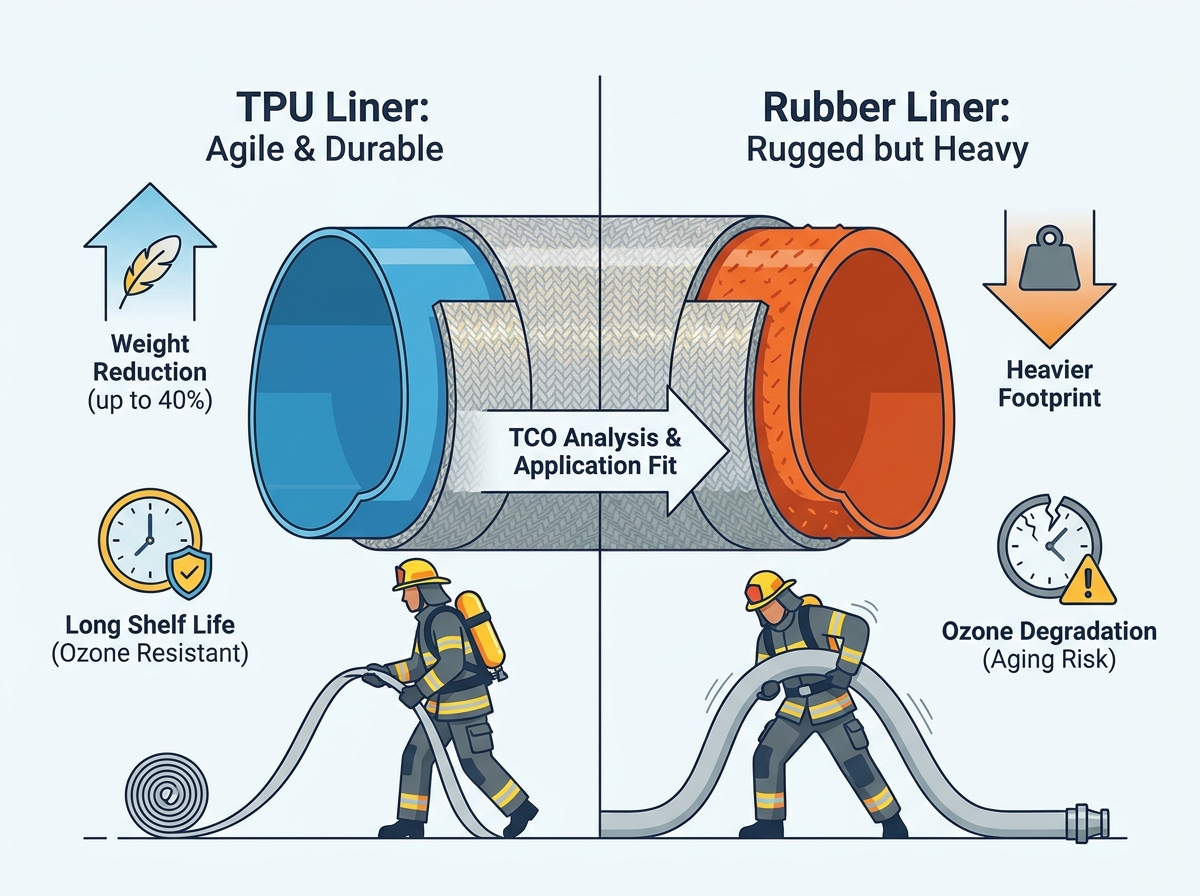
A modern TPU lined fire hose features extruded Thermoplastic Polyurethane. Manufacturers bond this advanced material directly to the woven jacket. They utilize intense heat processes instead of applying heavy liquid adhesives.
This streamlined design delivers massive operational advantages for rapid response teams. It provides an extreme weight reduction compared to legacy materials. The polyurethane liner measures incredibly thin but remains highly robust. This specific construction makes the hose lighter and much more compact. Crews can pack considerably more hoses onto a single apparatus bed. It also offers incredible chemical resilience and aging resistance. TPU remains practically immune to typical atmospheric ozone degradation. It actively resists mold, mildew, and many aggressive petrochemicals.
Hydraulic efficiency improves significantly during active pumping operations. The ultra-smooth inner bore minimizes internal fluid friction loss. This smooth surface allows high-volume water to travel further and faster. Pump operators can achieve higher nozzle pressures using less engine power.
Despite these profound benefits, you must note a few operational downsides. TPU carries a higher initial procurement cost per meter. Procurement budgets take a slightly larger hit on day one. The material can also be sensitive to extreme, direct heat sources. Glowing embers melting through the jacket can compromise a TPU liner quickly. Prolonged exposure to specific industrial solvents might also degrade it. Specialized synthetic rubbers handle highly aggressive solvents slightly better.
Procurement teams must compare these materials across strict operational dimensions. We evaluate TPU lined fire hose vs rubber lined models extensively below. The right choice depends entirely on your unique daily deployment challenges.
Deployability heavily favors modern lightweight materials in nearly every scenario. TPU wins on sheer weight reduction and compact rolling capabilities. Rubber requires significantly more personnel to move large-diameter hoses safely. Ergonomics improve instantly when crews handle lighter equipment on the fireground. Firefighters navigate high-rise stairwells much faster carrying lightweight TPU packs.
Shelf life dictates your long-term replacement cycles and maintenance schedules. Rubber requires careful rotation and climate-conscious storage routines. Crews must periodically unpack, wash, and thoroughly dry rubber hoses. TPU allows for highly reliable "store and forget" operational protocols. It avoids the dry rotting issues incredibly common in older rubber hoses. You can safely leave TPU packed in a cabinet for years.
Temperature extremes test both materials very differently in the field. Rubber performs exceptionally well in high ambient heat environments. TPU maintains superior physical flexibility in freezing winter conditions. Sub-zero temperatures will never cause a TPU liner to crack or shatter. Winter firefighting operations strictly demand the flexibility of modern polyurethane.
Lifecycle value varies heavily based on your financial perspective. Rubber wins when you face extremely strict initial budget constraints. TPU delivers vastly better long-term financial projections across a decade. It dramatically reduces routine maintenance hours and required physical labor. It extends the functional time between mandatory replacement cycles significantly.
Evaluation Criteria | Thermoplastic Polyurethane (TPU) | Vulcanized Rubber (EPDM) |
|---|---|---|
Weight & Ergonomics | Ultra-lightweight, compact rolling | Heavy, requires bulky storage |
Hydraulic Friction Loss | Minimal (ultra-smooth bore) | Moderate (slight surface texture) |
Cold Weather Flexibility | Excellent (no cracking below freezing) | Poor (stiffens and hardens rapidly) |
Extreme Heat Resistance | Moderate (vulnerable to direct embers) | Superior (thick insulation factor) |
Ozone & Aging Resistance | High (immune to rot and mildew) | Low (prone to cracking over time) |
Initial Procurement Cost | Premium (higher upfront investment) | Economical (lower day-one cost) |
The primary failure point for any lined hose remains structural delamination. This failure occurs when the internal liner separates from the outer jacket. Extreme water pressure can cause catastrophic internal bubbling if this happens. A bubbled liner completely blocks water flow during an active emergency.
You should request specific testing protocols from prospective suppliers. Do this before finalizing any major department purchase order.
Peel Adhesion Tests: These tests meticulously verify the bond strength between layers. Laboratories measure this resistance in Newtons per centimeter or pounds per inch. Higher numbers indicate a much more secure, durable physical bond.
Accelerated Aging Tests: Review lab data simulating years of intense ozone exposure. This reveals exactly how the material will behave over a decade. It guarantees the hose will survive long-term warehouse storage conditions.
Visual and Tactile Checks: Inspect sample cross-sections manually in your procurement office. Look for uniform material thickness across the entire inner diameter. Ensure the material shows an absolute absence of structural pinholes.
Best practices involve field-testing a sample length yourself. Pressurize the unit to verify physical performance firsthand. Common mistakes include ignoring accelerated aging data entirely during evaluation. Buyers often focus only on day-one burst pressure metrics. Long-term reliability matters just as much as initial burst strength.
Matching your equipment to the specific environment actively prevents premature failure. No single liner material works perfectly for every possible industry.
Municipal Fire Departments: We highly recommend TPU for all structural firefighting applications. Speed, weight reduction, and low friction loss remain intensely critical here. Lighter hoses allow rapid interior attacks up multiple flights of stairs. Faster deployment ultimately saves lives and minimizes costly property damage.
Forestry and Wildland: TPU stands out as the absolute best choice available. Wildland operations demand extreme portability above all else. Crews must hike across rugged terrain carrying their gear for miles. Every single pound matters when climbing steep, unpredictable hillsides.
Industrial and Petrochemical Plants: Specialized synthetic rubber often wins in these incredibly harsh sectors. Materials like EPDM or Nitrile handle heavy chemical exposure beautifully. They also withstand extreme localized heat threats far better than plastics. Dragging hoses over hot steel grating requires thick rubber insulation.
Agriculture and General Washdown: Standard rubber provides a fantastic budget-friendly option here. It offers heavy-duty drag resistance across rough concrete or rocky soil. Physical weight is rarely a primary constraint in these stationary applications. Farmers can easily drag heavy rubber hoses behind tractors without worry.
The final choice between these two materials comes down to distinct priorities. You must accurately decide what matters most for your daily operations. You evaluate deployment agility and longevity against upfront savings and industrial ruggedness. TPU thoroughly transforms physical mobility and completely eliminates storage rot. Rubber provides traditional heavy-duty bulk and unmatched high-heat durability.
To make the absolute best decision, take these actionable next steps:
Audit your current hose failure logs carefully to find common trends. Identify if your hoses fail primarily from ozone cracking or physical punctures.
Request specific lifecycle longevity calculations from competing hose suppliers. Ensure they base these estimates on your actual local operational environment.
Test sample sections of both materials under your typical field conditions. Evaluate handling ease, flexibility, and rolling compactness before committing funds.
Review your storage facilities for reliable climate control capabilities. Upgrade to TPU if your storage areas experience extreme temperature fluctuations.
A: Kinking largely depends on the specific jacket weave and active operational pressure. However, TPU is extremely thin and flexible. This thinness requires high-quality outer jacket construction to prevent folding. A well-designed woven jacket keeps a TPU hose perfectly rigid under pressure. Cheaply made jackets will invariably allow the hose to kink easily.
A: Neither internal liner material actively absorbs water. The outer jacket material actually dictates your overall mildew risk. While synthetic jackets resist moisture, the TPU liner itself remains entirely rot-proof. It never breaks down from dampness. Conversely, rubber can degrade if wet storage promotes localized bacterial growth.
A: TPU generally commands a premium initial price upfront. You should strictly frame this against the heavily extended replacement cycle. Longer shelf life and reduced operational liability offset the initial capital expense. Buyers frequently find TPU much more affordable over a ten-year span. You buy significantly fewer replacement hoses over the long term.
A: TPU offers a significantly longer shelf life overall. It actively resists ozone and ambient oxygen degradation. Rubber historically tends to dry out, crack, and harden when sitting idle. TPU remains highly flexible and ready for immediate deployment. You can completely trust it to work after prolonged facility storage.