
- All
- Product Name
- Product Keyword
- Product Model
- Product Summary
- Product Description
- Multi Field Search
 English
Views: 0 Author: Site Editor Publish Time: 2026-10-24 Origin: Site


Coupling failures during fluid transfer represent the highest risk point for environmental spills, compliance violations, and catastrophic downtime. A sudden separation releases hundreds of gallons of hazardous material in seconds. You cannot afford to ignore the early warning signs of these dangerous blowouts.
Even premium industrial hoses fail if the connection points are compromised by mechanical fatigue, chemical degradation, or improper assembly. The intersection where the flexible hose meets the rigid metal fitting bears the brunt of operational stress. Routine wear silently weakens these joints until they give way completely under pressure.
Mitigating tank truck hose coupling leaks requires shifting from reactive repairs to a structured, evidence-based inspection and replacement protocol. We will explore the root causes of these failures. You will also learn how to implement standardized inspection techniques and replacement strategies to protect your operators and the environment.
Most coupling leaks originate from preventable issues: improper torque, degraded gaskets, or mechanical stress from dragging.
Regular visual and tactile inspections must be supported by scheduled hydrostatic pressure testing to identify internal failure points.
Verifying exact fuel hose gasket compatibility with the specific chemicals or fuels being transferred is critical to preventing seal degradation.
Industry compliance strictly limits field repairs; in most commercial tank truck applications, a compromised coupling necessitates full assembly replacement.
Minor weeping at a connection point is a leading indicator of an impending blowout. Operators often dismiss a slow drip as a normal nuisance. This assumption is incredibly dangerous. Fluid bypassing the coupling seal means the internal structure has already failed. The remaining physical connection is holding on by a fraction of its intended strength. When full working pressure applies, the weakened assembly violently separates.
The financial consequences of a ruptured transfer line escalate rapidly. The EPA heavily penalizes hazardous material spills. You face immediate cleanup costs, soil remediation expenses, and stiff environmental fines. The Department of Transportation (DOT) routinely inspects commercial tank trucks. Inspectors strictly enforce regulations regarding hose integrity. A single weeping fitting can trigger an immediate out-of-service violation. This forces your truck to sit idle until a certified replacement arrives. Lost transit time directly harms your operational revenue.
We must prioritize the physical safety of the operators. Pressurized chemical or petroleum transfer creates immense potential energy. If a cam-and-groove or threaded fitting fails, the heavy metal coupling acts like a projectile. It can strike operators with bone-crushing force. Additionally, a sudden leak sprays highly toxic or flammable liquids directly onto the worker. This exposure causes severe chemical burns, respiratory damage, or fatal fire hazards. Protecting your workforce demands zero tolerance for coupling leaks.
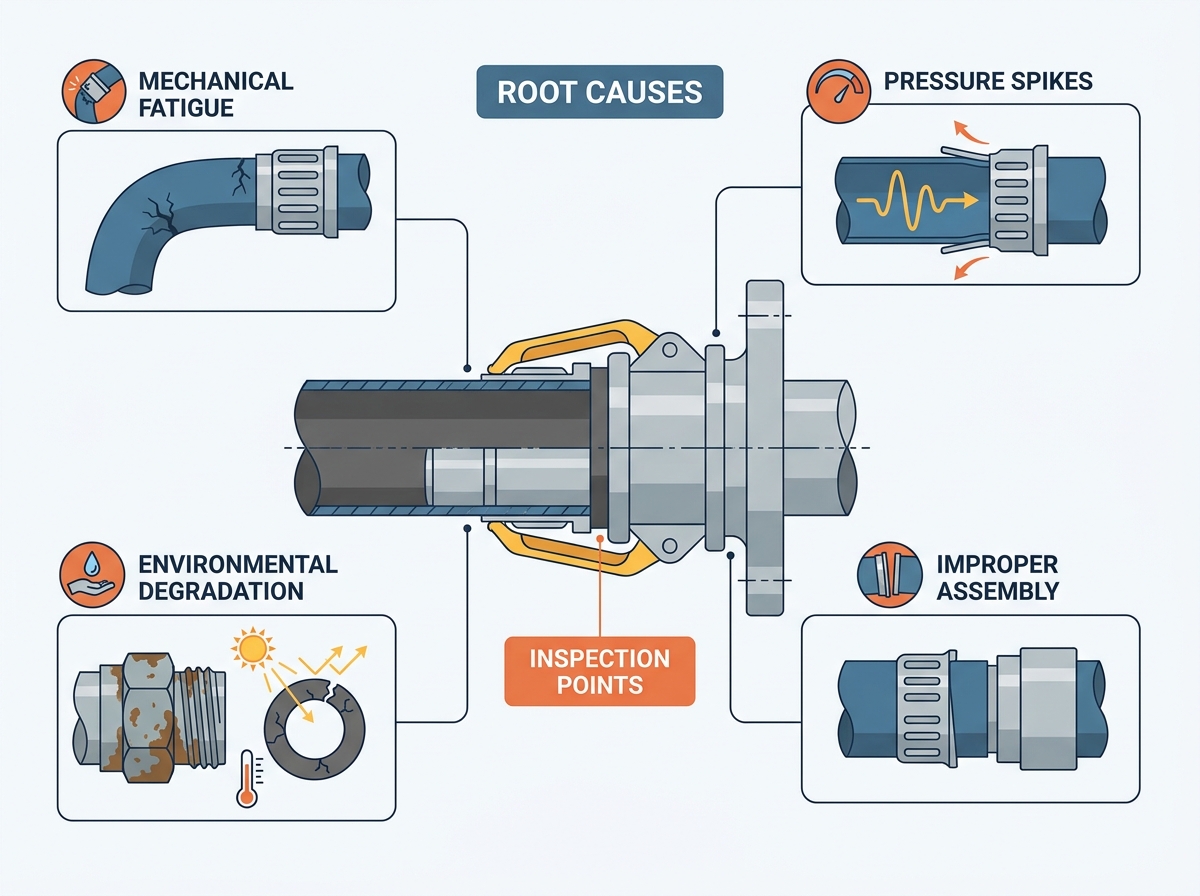
Couplings do not leak without a reason. Identifying the exact mechanism of failure helps you prevent identical issues in the future. We categorize these root causes into four primary domains.
Hoses endure severe physical abuse daily. Operators frequently over-bend the hose right at the coupling shank. This creates a severe kink. The metal shank cuts into the inner rubber tube. Furthermore, dragging hoses across concrete damages the external ferrule. The abrasive surface grinds away the metal. This reduces the structural clamping force holding the fitting in place. Transit vibration also plays a role. As the truck bounces down the highway, the heavy metal fittings vibrate aggressively, slowly wearing down the connection.
Fluid dynamics heavily impact hose longevity. Rapid valve closures cause severe pressure surges. Engineers call this the water hammer effect. When thousands of gallons of moving fluid suddenly stop, the kinetic energy transforms into a massive pressure wave. This shockwave hits the hose couplings first. Over time, these repeated impacts slowly unseat crimped or banded couplings. The gradual stretching of the metal ferrule eventually creates a pathway for leaks.
Not all hose assemblies are created equal. Non-certified shops often ignore strict manufacturing tolerances. They use mismatched couplings and hoses. An under-crimped ferrule lacks the necessary grip to hold the fitting under pressure. An over-crimped ferrule crushes the inner tube, creating immediate microscopic fractures. You must source assemblies from certified distributors who use calibrated crimping machines.
The operating environment constantly attacks the hose materials. Consider these common environmental stressors:
UV Exposure: Direct sunlight degrades synthetic rubber. The exterior cover becomes brittle and cracks.
Temperature Fluctuations: Extreme heat softens the rubber, while extreme cold makes it rigid. This constant expansion and contraction weakens the seal.
External Corrosion: Salt, road debris, and chemical vapors corrode aluminum and steel fittings. Rust eats away at the threads and locking mechanisms.
Preventing blowouts requires a disciplined maintenance routine. You must implement a rigorous tank truck hose connection inspection schedule. Relying on casual glances during fluid transfer is insufficient.
Drivers must perform daily visual checks before the first dispatch. This habit catches obvious physical damage before the hose pressurizes.
Check for coupling slippage: Look closely at the base of the metal fitting. If you see bare, unweathered hose exposed right behind the ferrule, the coupling is slipping. Retire it immediately.
Look for cracks and pitting: Inspect the male and female ends. Pitted metal indicates severe corrosion. Worn threads prevent a secure, tight seal.
Inspect cam arm pins: Check the cam-and-groove locking arms. The pins must be straight. The rings must engage securely without excessive play.
Maintenance personnel must conduct deeper physical evaluations during scheduled depot stops. Visual checks miss internal degradation.
Feel for soft spots: Run your hands firmly over the hose immediately behind the coupling. Soft, mushy spots indicate internal fluid bypass. Hard, brittle areas suggest severe heat degradation.
Measure the crimp OD: Use a digital caliper to measure the outside diameter of the crimped ferrule. Compare this measurement against the manufacturer's original baseline specifications. If the metal has expanded, it has lost its clamping force.
Static checks cannot replicate operating conditions. You must observe the hose under low-pressure transfer. Initiate the pump slowly. Watch the connection point carefully. Look for microscopic weeping or bubbling. Pay close attention to abnormal hose twisting. If the hose aggressively torques or twists at the coupling, the internal reinforcement layers are failing.
The finest metal coupling will leak instantly if the internal rubber gasket fails. Gaskets form the critical barrier between the fluid and the outside world. Using the wrong gasket material guarantees an eventual environmental spill.
Incompatible fluids aggressively attack rubber compounds. When a gasket encounters the wrong chemical, it degrades rapidly. You might notice the rubber swelling to twice its normal size. Sometimes it becomes sticky and gummy. In other cases, it dries out completely and fractures under compression. These chemical attacks destroy the integrity of the seal, allowing fluid to bypass the locking mechanism.
You must establish strict guidelines for fuel hose gasket compatibility based on your specific payloads.
Gasket Material Selection and Compatibility Guide
Gasket Material | Primary Compatibility | Not Recommended For |
|---|---|---|
Buna-N (Nitrile) | Standard petroleum products, diesel, light oils, water. | Strong acids, harsh solvents, ozone exposure. |
Viton (FKM) | Aggressive chemicals, biodiesel blends, high-temperature fuels. | Ketones, steam, extremely cold temperatures. |
Teflon (PTFE) | Nearly universal chemical resistance, highly corrosive solvents. | Applications requiring high rubber elasticity. |
EPDM | Acids, alkalis, hot water, agricultural fertilizers. | Petroleum-based fuels, oils, lubricants. |
Temperature profoundly impacts gasket performance. Extreme cold reduces rubber elasticity. The material approaches its glass transition phase, becoming rigid and hard. When you connect a frozen hose, the rigid gasket cannot compress properly. This causes temporary weeping leaks until the warm fluid heats the system. You must select specially compounded cold-weather seals if operating in northern climates.
Many operators treat gaskets as permanent fixtures. This is a critical mistake. Treat gaskets as high-frequency consumables. You compress and decompress them multiple times a day. Replace them proactively during scheduled maintenance windows. Do not wait for them to fail during a transfer operation.
When you discover a compromised hose coupling, you face a critical decision. Do you attempt a repair, or do you replace the entire assembly? In the commercial tank truck industry, safety standards heavily dictate this choice.
Industry associations like NAHAD (The Association for Hose and Accessories Distribution) provide explicit guidelines. Their standard clearly states you should generally never repair or re-couple hoses used for hazardous materials. Once a coupling is crimped, it permanently compresses the inner rubber tube. Removing the old fitting leaves a damaged, crushed zone. Applying a new fitting over this damaged rubber guarantees a weak connection. For hazardous liquid transfer, field repairs violate basic safety protocols.
You must evaluate assemblies using strict, unyielding criteria. Do not rely on guesswork.
Age and Service Life: Track your hose assemblies rigorously. Use RFID chips or permanently etched metal tags. Enforce strict time-based retirement schedules regardless of visual appearance. Many chemical hoses degrade internally long before they show exterior wear.
Damage Severity: Certain types of damage mandate immediate, non-negotiable replacement. If you see exposed wire braids, the structural integrity is gone. If you detect any coupling slippage, remove the hose from service. If the outer carcass shows deep cuts reaching the reinforcement layer, cut the hose in half and discard it.
Drivers often attempt "quick fixes" on the road to finish a delivery. They might apply heavy-duty tape or add screw-style band clamps to a weeping crimped assembly. This false economy creates immense danger. A band clamp cannot contain the pressure of an industrial transfer pump. It provides a false sense of security. You must insist on using only factory-certified, pressure-tested assemblies. The cost of a new hose pales in comparison to the liability of a catastrophic spill.
Standardizing these protocols across an entire fleet requires organization and discipline. You cannot rely on individual drivers to interpret maintenance rules differently. You must build a scalable, consistent system.
Visual inspections only catch obvious, late-stage failures. To ensure true reliability, establish a scheduled hydrostatic testing program. Test every transfer hose annually or bi-annually. The standard procedure involves filling the hose with water and pressurizing it to 1.5 times its maximum stated working pressure. Hold this pressure for several minutes. This safely exposes internal weaknesses, tiny pinhole leaks, and weakened coupling crimps in a controlled environment.
Fragmented purchasing leads to inconsistent safety standards. If different depot managers buy hoses from random local suppliers, you cannot guarantee uniform quality. Consolidate your hose and coupling suppliers. Partner with a certified distributor who adheres to NAHAD guidelines. This ensures uniform crimp specifications, identical material quality, and predictable lifespans across the entire fleet.
Testing and inspections hold little value if you cannot prove they occurred. Maintain meticulous digital logs. Record the dates of all visual inspections. Log the specific results of every hydrostatic pressure test. Track the exact replacement cycles for every single hose assembly using its unique serial number. When DOT or FMCSA auditors inspect your facility, these comprehensive digital records demonstrate your commitment to environmental and operator safety.
Eliminating coupling leaks requires a fundamental shift in perspective. You must treat the flexible hose, the metal coupling, and the internal rubber gasket as a singular, heavily engineered system. They are not merely interchangeable parts you can swap blindly. Ignoring the mechanical tolerances between these components guarantees failure. Preventative maintenance, rigorous inspection routines, and strict adherence to replacement guidelines will drastically reduce your risk profile.
Take immediate action to secure your transfer operations. We recommend auditing your current fleet hose assemblies today. Look closely for any signs of coupling slippage or external damage. Verify your gasket materials perfectly match your current chemical payloads. Finally, partner with a certified industrial hose distributor to source compliant, factory-tested replacements before a minor weep turns into a major disaster.
A: Industry standards typically require hydrostatic pressure testing at least once annually. However, this timeframe depends on your specific application. If you transfer highly aggressive chemicals or operate in extreme environments, you should test bi-annually. Always consult specific DOT and EPA regulatory requirements for your exact hazmat payload.
A: The most frequent culprits are worn or flattened gaskets. Operators often forget to replace them. Other common causes include using incompatible seal materials that degrade upon chemical contact, and bent cam arms that prevent the fitting from achieving full, even compression.
A: No. Safety standards strictly prohibit re-crimping used hazardous material hoses. The original crimp permanently compresses and alters the inner rubber tube. Re-crimping the same area fails to create a secure seal, drastically increasing the risk of a catastrophic blowout under pressure. You must replace the entire assembly.