
- All
- Product Name
- Product Keyword
- Product Model
- Product Summary
- Product Description
- Multi Field Search
 English
Views: 0 Author: Site Editor Publish Time: 2026-10-23 Origin: Site


A flattened or inverted hose during a fluid transfer operation is never just a minor inconvenience. It represents an immediate operational halt. Such failures risk severe pump damage, safety hazards, and environmental contamination. Suction hoses are specifically engineered to withstand intense internal negative pressure during operation. Unfortunately, structural fatigue, improper component specification, or daily operational errors can easily cause this critical structural reinforcement to fail. For fleet operators and facility managers, understanding the root causes of a fuel transfer hose suction collapse is critical for specifying the correct replacement and preventing costly downtime. This guide breaks down the specific physical mechanics behind hose collapse and the broader business impact of these failures. You will also discover an evidence-based framework for evaluating and selecting robust industrial fuel suction hoses.
Structural Failure is Often Secondary: Hose collapse is typically the symptom of a blocked tank vent, a compromised helical wire, or chemical degradation, rather than a spontaneous defect.
Vacuum Ratings are Non-Negotiable: A standard discharge hose cannot substitute for a rated suction hose; operators must verify the oil suction hose vacuum rating (typically up to 29 inHg) for unloading applications.
Hidden Costs: A collapsed hose frequently leads to pump cavitation, causing internal pump damage that far exceeds the replacement cost of the hose itself.
Evaluation Focus: Upgrading to crush-resistant dual-helix designs or high-aromatic-resistant elastomers reduces long-term replacement frequency.
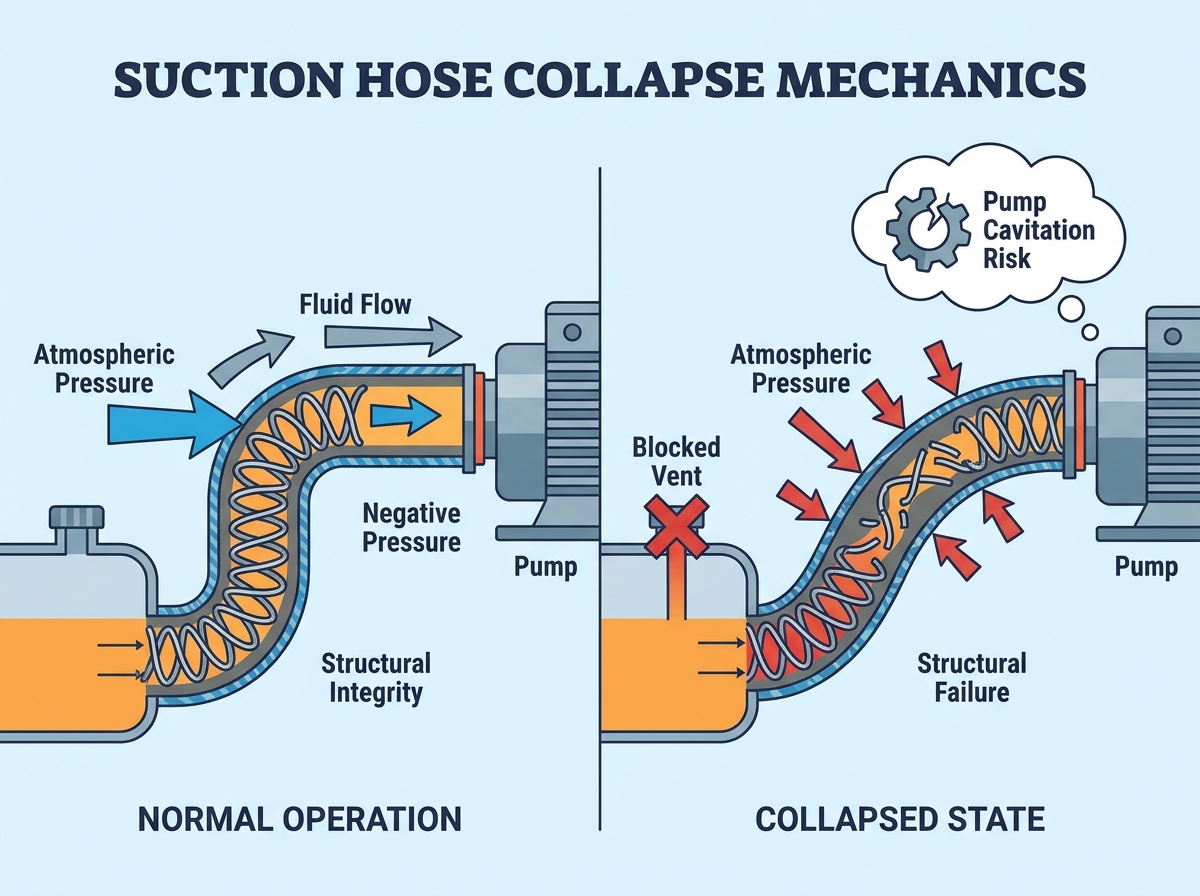
We often misunderstand how suction actually works in industrial applications. You might assume pumps physically "pull" fluid through a line. In reality, pumps simply displace air and fluid. This action creates a void or a zone of negative pressure inside the piping. Once this internal pressure drops, standard atmospheric pressure pushes down on the fluid source. This external pressure forces the fuel into the line to fill the newly created void.
Because atmospheric pressure pushes against the outside of the assembly, standard rubber tubes would instantly flatten. They need structural support. This is where the helical wire becomes essential. Manufacturers embed a rigid steel or hard PVC helix inside the rubber layers. This spiral structure acts like a skeleton. It fights against the external atmospheric weight. It maintains the internal volume and keeps the fluid pathway wide open.
A collapse occurs precisely when this external pressure overcomes the structural integrity of the helix. Several variables can trigger this structural failure. Sometimes the wire bends. Sometimes the surrounding rubber softens. When the helix yields, the tube buckles inward immediately. The flow stops, but the pump continues running. This creates a dangerous scenario for your equipment and personnel.
Understanding why your equipment fails requires looking at daily operations. Failures rarely happen spontaneously. They usually stem from one of four primary issues.
Improper Venting (Operational Error): Storage tanks must breathe during fluid transfer. As you pump fuel out, air must enter the tank to replace the lost liquid volume. A clogged or accidentally closed vent creates a vacuum lock inside the storage tank. The pump continues to draw fluid, drastically increasing the negative pressure. Eventually, this force exceeds the engineered limits of the helix, forcing the walls to cave in.
Exceeding Vacuum Specifications (Application Mismatch): Operators sometimes grab whatever equipment is closest. Using a gravity-drop or discharge-only product for a high-suction application is highly dangerous. Discharge lines lack the rigid wire skeleton needed for negative pressure. Ignoring the manufacturer's stated tank truck unloading hose collapse thresholds virtually guarantees a mid-transfer failure.
Mechanical Fatigue and Crush Damage (Environmental Wear): Industrial transfer yards are hazardous environments. Service vehicles frequently run over loose lines. Operators drag them across abrasive concrete surfaces. These actions bend, kink, or break the internal wire helix. Once you compromise the metal skeleton, it loses its uniform strength. The next time you apply suction, the weakened section will instantly buckle.
Chemical and Thermal Degradation (Material Incompatibility): Rubber compounds react differently to various chemicals. Exposure to incompatible fuel blends, like high aromatics or concentrated biodiesel, degrades standard rubber. Extreme ambient temperatures also soften the elastomer. When the rubber softens, it stops holding the internal wire firmly in place. The helix shifts under pressure, leading to a rapid structural collapse.
A flattened transfer line represents a much larger financial threat than the mere price of a replacement part. The ripple effects hit your operational budget hard. You must account for equipment damage, safety violations, and lost time.
Pump cavitation is the most immediate threat. When a collapse blocks the fluid pathway, the pump starts dry-running. It continues trying to move fluid, dropping the internal pressure so low that the remaining liquid literally boils at ambient temperatures. This creates vapor bubbles. When these bubbles reach the higher-pressure side of the pump, they implode violently. These microscopic implosions pit and destroy metal impellers in minutes. A ruined pump requires expensive rebuilds and extended downtime.
Environmental and safety compliance risks also escalate. Once a structure collapses, the internal layers stretch and sustain micro-tears. Even if it pops back into shape, the damage remains. When you eventually reintroduce positive pressure during a different operation, those weak spots become leak points. Spraying hazardous fuels across a facility triggers EPA fines, cleanup mandates, and severe safety audits.
You also face severe downtime metrics. Consider the cascading delays:
Idle driver time waiting for a replacement.
Delayed dispatch schedules affecting downstream deliveries.
Potential facility shutdowns if you cannot safely offload critical fuel supplies.
Replacing failed equipment requires a deliberate evaluation process. You cannot simply order the cheapest option available. You must match the engineering specifications to your exact operational realities.
Decoding the oil suction hose vacuum rating is your first step. Industrial standards usually require a "Full Vacuum" rating. This translates to 29 inHg (inches of mercury). It means the structure can withstand nearly absolute negative pressure without buckling. Buyers must demand documented testing certificates from suppliers. Never accept a manufacturer's verbal promise. Ask for hydrostatic and vacuum test reports.
Material selection for modern fuels requires careful attention. Standard Nitrile (Buna-N) works well for traditional petroleum products. However, today's market uses diverse blends. Higher-aromatic fuels and biofuels (like B20 or B100) require specialized elastomers. Materials like Viton or advanced synthetic blends prevent tube softening. They resist chemical attacks and maintain the structural integrity of the helix.
Cover design dictates how the product handles daily physical abuse. You must choose between corrugated and smooth covers.
Hose Cover Design Comparison
Design Feature | Primary Advantages | Common Drawbacks | Best Application |
|---|---|---|---|
Corrugated Cover | Exceptional flexibility; easier for drivers to bend and maneuver. | Ridges can trap dirt; slightly more prone to snagging. | Tight transfer yards requiring complex routing. |
Smooth Cover | High abrasion resistance; easy to drag across rough concrete. | Stiffer profile; requires a larger minimum bend radius. | Heavy-duty unpaved sites or straight-line transfers. |
Finally, evaluate the helix architecture. A standard single-wire helix offers basic protection but permanently deforms if crushed. For high-traffic areas, specify crush-resistant designs. These utilize woven synthetic materials or a dual monofilament helix. If accidentally driven over, they rebound to their original shape. This feature alone drastically reduces your replacement frequency.
Buying the right equipment only solves half the problem. You must implement strict operational protocols to extend its lifespan. Proper handling prevents the mechanical fatigue we discussed earlier.
Start by establishing rigid pre-transfer inspection protocols. Operators need a baseline checklist before ever engaging the pump. They should physically run their hands along the cover. They must check for soft spots, exposed wire, deep abrasions, or permanent kinks. If an operator spots a localized soft spot, they must remove it from service immediately. A soft spot indicates a broken helix.
Proper storage and handling eliminate unnecessary stress fractures. Never leave transfer lines lying across active driving lanes. Implement specialized storage racks and industrial reels. These systems enforce a safe minimum bend radius. Bending equipment too tightly stretches the outer wall and compresses the inner wall. This localized stress fractures the helical wire over time.
Rollout considerations require vetting your vendors carefully. Prioritize suppliers who offer comprehensive support. Look for vendors providing serialized tracking. This allows you to monitor the lifespan of each specific unit across your fleet. They should also offer clear warranty terms regarding vacuum failures and provide periodic hydrostatic re-testing services.
A collapsed suction assembly represents a highly preventable failure. These incidents stem directly from mismatched specifications, inadequate maintenance, or daily operational oversights. Pumps displace fluid, and your equipment must be strong enough to withstand the resulting atmospheric pressure.
Upgrading to properly specified equipment eliminates catastrophic pump cavitation risks. You must select the correct vacuum rating, ensure chemical compatibility with modern fuels, and choose a helix architecture suited for your environment. Taking these steps secures your supply chain and protects your bottom line.
Audit your current fleet immediately. Check your documented vacuum ratings against your maximum pump capacities. If you find discrepancies, consult with a certified distributor to source tailored, crush-resistant replacements before your next major failure occurs.
A: No. Once the internal helical wire becomes permanently deformed or broken, the structural integrity is completely lost. You cannot pop it back into a safe working condition. The hose must be removed from service immediately to prevent sudden failure and severe pump damage.
A: It refers to inches of mercury (inHg). A rating of 29 inHg represents a "full vacuum." This means the product can withstand nearly absolute negative internal pressure without collapsing. This standard is required for heavy-duty tank truck unloading applications.
A: Cold temperatures make elastomer compounds extremely rigid and brittle. If you bend the equipment beyond its minimum bend radius while it is freezing, the internal structure can fracture. This hidden damage leads directly to a rapid collapse under suction.
A: Yes. Gravity drop hoses are designed for fluid transfer aided solely by gravity. They typically lack the heavy helical wire reinforcement required to withstand the intense negative pressure generated by a mechanical pump. Using them for suction will cause failure.