
- All
- Product Name
- Product Keyword
- Product Model
- Product Summary
- Product Description
- Multi Field Search
 English
Views: 0 Author: Site Editor Publish Time: 2026-10-07 Origin: Site


Industrial fluid transfer operations face severe operational risks during the winter months. Pumping fuel, dewatering sites, and supplying firefighting lines become treacherous tasks when temperatures plummet. Equipment failure, cracking, and catastrophic loss of flexibility routinely plague these operations. Traditional materials like PVC or standard rubber become dangerously brittle in freezing conditions. This sudden brittleness leads to unexpected downtime and severe safety hazards on site.
Thermoplastic Polyurethane (TPU) provides a robust resolution for these extreme environments. However, buyers must understand its exact behavioral changes in sub-zero climates. You cannot treat cold TPU exactly like warm TPU. This guide breaks down the physical limitations, handling protocols, and storage requirements for TPU hoses in freezing conditions. You will learn how to maintain fluid flow and protect your infrastructure when the cold sets in.
Material Resilience: TPU maintains structural integrity and avoids the brittle-cracking typical of PVC in sub-zero environments, though minor stiffness increases are expected.
Deployment Adjustments: Handling requires modified deployment speeds and increased bend radius allowances to prevent mechanical stress on cold polymer chains.
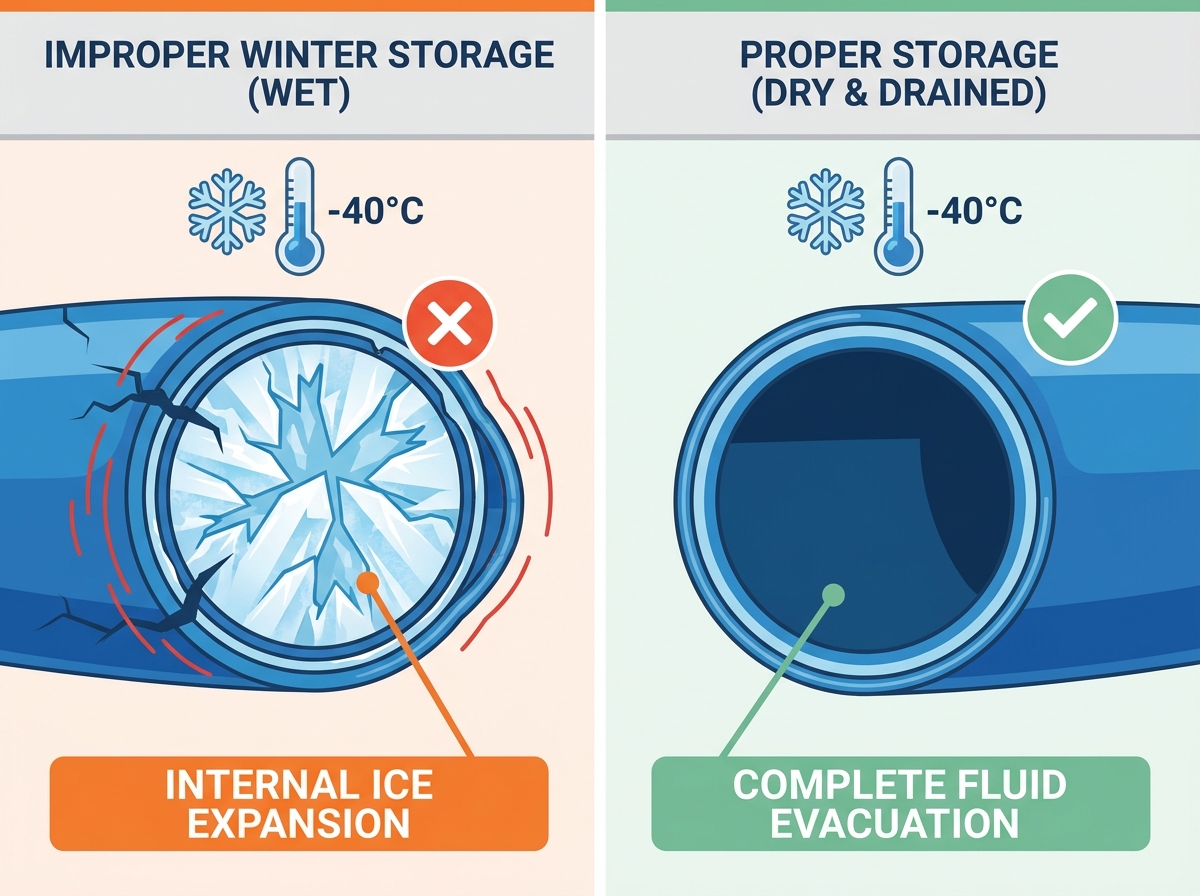
Critical Storage: Proper layflat hose winter storage requires complete fluid evacuation; residual ice expansion causes more internal jacket damage than ambient cold.
Specification Baseline: Standard TPU hoses operate safely down to -58°F (-50°C), but dynamic handling (rolling/unrolling) should be minimized at the absolute lower limits of this threshold.
All polymers react to dropping temperatures, but they do not react equally. The glass transition point dictates when a flexible material turns rigid and glassy. PVC and Nitrile rubber have relatively high glass transition temperatures. When exposed to freezing weather, they harden quickly and shatter under pressure. TPU outperforms these traditional options significantly. Its lower glass transition temperature means it remains elastomeric. It stays rubbery and functional in extreme weather instead of turning into a fragile shell.
Operators must distinguish between stiffness and brittleness. A freezing environment will alter the physical feel of your equipment. While TPU hose flexibility at low temperature remains vastly superior to alternatives, you will still experience increased rigidity compared to summer handling. It simply takes more mechanical force to coil and uncoil the line. The material gets stiffer, but it does not become brittle. It bends reluctantly, but it refuses to crack.
Winter worksites present harsh physical hazards. You often drag equipment over jagged ice, sharp rocks, and frozen mud. TPU hoses feature an interwoven polyester or polyamide jacket. Manufacturers combine this strong jacket with an extruded TPU cover. This unified structure maintains exceptional impact resistance. The cover shields the internal weave from ice abrasions. Even when stiff from the cold, the extruded cover deflects sharp environmental impacts, reducing the risk of catastrophic punctures.
Mechanical reel deployment speeds must change during winter operations. Cold polymer chains do not stretch or adapt as quickly as warm ones. We highly recommend reducing the speed of mechanical reel deployment. Sudden shocks can severely stress the coupling joints. High-speed unspooling forces the cold material to flex too rapidly. This rapid flexing strains the integration point between the metal coupling and the polyurethane jacket.
Operators must accommodate a moderately larger bend radius during winter tasks. You cannot force cold equipment into the same tight corners you use in July. Forcing a tight bend on a frozen hose increases the risk of micro-creasing. These microscopic creases form in the extrusion layer. Over time, repeated micro-creasing degrades the structural integrity of the line. Plan your deployment routes to allow for wide, sweeping turns rather than sharp angles.
Frozen terrain drastically increases friction. External ice buildup presents a major operational hurdle. When you drag lines through slush, the moisture often freezes directly onto the jacket. This ice adhesion increases the handling weight significantly. It complicates retrieval and demands stronger winch capacities. Field teams should monitor ice buildup closely to prevent overloading retrieval machinery.
The external material handles the cold brilliantly, but the internal fluid dynamics change. Cold weather thickens liquids. High-viscosity fuels or slushy water resist movement. When you initiate flow, these sluggish fluids exert higher internal pressures during start-up. Operators should ramp up pumping pressure gradually. A sudden high-pressure surge against a stiffened jacket and highly viscous fluid can stress the system unnecessarily.
Different industries face unique winter challenges. Understanding these specific scenarios helps operational planners optimize their field strategies.
Oilfield Dewatering & Drilling: Winter fuel transfer and rapid flood response demand relentless reliability. Oilfields operate continuously in harsh environments. Teams require equipment that resists freezing hydrocarbons while maintaining high throughput. TPU excels here because it resists chemical degradation even at sub-zero temperatures.
Municipal and Wildland Firefighting: Winter firefighting introduces extreme safety stakes. Emergency responders need immediate water flow. High burst-pressure retention remains an absolute necessity. Fire hoses often face sustained sub-zero temperatures on active fire grounds. The jacket must survive being frozen to the street while holding back immense water pressure.
Agriculture and Mining: Remote water transfer often spans miles of uneven terrain. Mining operators frequently leave hoses static on frozen ground for extended periods. The success criteria rely on the material surviving static freezing conditions and remaining functional for eventual retrieval weeks later.
The single highest risk to a TPU layflat hose cold weather operation is internal ice expansion. Water expands as it freezes. If you leave fluid inside, the expanding ice acts like a knife. It tears the internal jacket apart from the inside out. Outline strict protocols for pigging or gravity-draining your lines before coiling. An empty line survives winter easily; a full line ruptures.
Field teams should adapt their coiling habits when temperatures drop drastically. We recommend coiling hoses loosely if they must be rolled outdoors at extreme low temperatures. Avoid forcing a tight spool in the snow. Instead, secure the loose coil, transport it, and delay tight spooling until the unit has acclimated to a warmer staging area.
Choosing the right storage environment extends equipment life. Warehouse storage always beats field storage. However, if you must store inventory outdoors, elevate it. Proper layflat hose winter storage dictates keeping lines off the frozen mud. Ground moisture will freeze the coils together, creating an ice-lock. Furthermore, keep them covered. Winter UV exposure compounds material degradation and accelerates wear.
Sometimes equipment freezes solid on site. You must thaw it safely. Provide clear guidelines for thawing a frozen line. Ambient warehouse warming serves as the safest method. Unroll the line as much as possible and let room temperature do the work. Warn your crews strictly against using open flames, steam lances, or high-heat impact tools. Extreme localized heat destroys the polyurethane matrix instantly.
Procurement teams must know how to read manufacturer specification sheets correctly. You must differentiate between "survival temperature" and "handling temperature." A survival temperature dictates the lowest point the material can withstand while resting statically. The dynamic handling temperature dictates the lowest point you can safely unroll, bend, and retrieve the equipment. Always ask for the dynamic rating.
Manufacturing methods matter immensely in freezing climates. Look for through-the-weave extrusion. This process pushes the polyurethane directly through the woven fabric jacket, bonding them permanently. This integration prevents delamination when the outer layer freezes and shrinks slightly. Cheaper, glued layers will peel apart under winter stress.
Cold weather changes metal dynamics. Aluminum or stainless steel couplings expand and contract at different rates than polyurethane. Assess how extreme cold affects clamp security. A loose clamp leads to a blowout. Ensure your vendor utilizes binding methods that compensate for thermal contraction in freezing environments.
Do not accept marketing claims blindly. Ask your suppliers direct, technical questions. Request cold-cracking test data. Ask them, "What is the recommended dynamic bend radius at -20°C?" A reputable vendor will provide laboratory test results proving their material withstands dynamic handling in sub-zero conditions.
Use the following criteria when reviewing vendor specifications for winter equipment.
Evaluation Metric | Standard Requirement | Winter-Ready Requirement |
|---|---|---|
Extrusion Method | Adhesive Bonded | Through-the-weave Extrusion |
Dynamic Handling Temp | -4°F (-20°C) | -40°F (-40°C) or lower |
Cold Cracking Data | Not Provided | Certified Lab Results Available |
Coupling Integration | Standard Banding | Thermal-Contraction Compensated Binding |
TPU stands as the definitive material choice for cold-weather fluid transfer. It outperforms traditional rubber and PVC reliably. However, operational success demands that operators respect its physical changes and adjust handling speeds accordingly. The material will stiffen, but it will not fail if handled with care.
Remember that risk mitigation starts with your field team. The vast majority of cold-weather failures stem from improper draining and forced mechanical bending. They rarely stem from actual material failure. Keep the lines empty when static, and bend them gently when cold.
We recommend taking immediate action before the deep freeze arrives. Procurement teams should audit their current winter failure rates. Request low-temperature test certificates from your TPU suppliers today. Finally, update your field handling standard operating procedures (SOPs) to reflect proper winter deployment speeds and storage techniques.
A: Most high-quality TPU lines maintain dynamic flexibility down to between -40°F and -58°F. As you approach this limit, physical resistance increases gradually. You will need more effort to roll it, but the material will not shatter.
A: Yes, provided it remains completely empty or maintains continuous, uninterrupted fluid flow. If you leave a static, full line outside in freezing weather, the internal water will freeze, expand, and rupture the jacket.
A: No. Cold weather causes temporary stiffness. Once you return the equipment to normal ambient temperatures, it regains its original flexibility entirely. No molecular degradation occurs, assuming nobody forced mechanical cracking while it was frozen.
A: Use rubber mallets gently to tap the external jacket. This breaks the ice adhesion without damaging the polyurethane. Never use sharp tools, ice picks, or excessive impact force to clear the line.