
- All
- Product Name
- Product Keyword
- Product Model
- Product Summary
- Product Description
- Multi Field Search
 English
Views: 0 Author: Site Editor Publish Time: 2026-10-18 Origin: Site


Hydraulic and pneumatic fluid lines serve as the vital arteries of modern mining operations. However, harsh operational environments constantly threaten these essential connections. You cannot afford unexpected equipment blowouts deep underground or at a remote surface site.
Unprotected lines continuously drag against jagged substrates. They endure extreme wear during daily operations. Heavy machinery driving over them further compounds the physical damage. This constant abuse results in premature failure and severe safety hazards. Workers face life-threatening risks from high-pressure fluid injection injuries. Operations also suffer massive financial losses from abruptly halted production schedules.
We will explore how to shield your fluid conveyance systems effectively. You will discover a robust technical evaluation framework. This guide helps maintenance and procurement teams select appropriate defenses. We will show you how to match protection methods to specific wear vectors and installation constraints.
Matching the protection method to the specific wear vector (continuous dragging vs. static vibration) is more cost-effective than universally applying the thickest guard.
MSHA-approved flame resistance is a non-negotiable compliance standard for underground mining hose protection.
Retrofitting existing assemblies requires different protective form factors (like spiral wrap) compared to OEM or new-build installations.
Properly specified hose crossing solutions prevent crush damage while maintaining necessary flexibility and access.
Understanding exactly how your equipment degrades is the first step toward effective mitigation. Wear patterns differ significantly across various mining applications. You must diagnose the specific mechanical forces attacking your fluid lines. This ensures you apply the correct defensive strategy.
Mobile equipment constantly moves across unforgiving terrain. Longwall shearers and drill rigs pull lines across abrasive quartz, granite, or loose shale. This friction tears through standard outer covers quickly. Once the steel wire reinforcement exposes, rusting and failure follow rapidly. Effectively mitigating mining hose rock abrasion begins by addressing this continuous dragging action. You need highly durable outer shields to deflect this sliding wear.
Friction occurs even when machinery sits seemingly idle. Static lines often rest against sharp rock faces. They also rub against vibrating metal chassis components. Over time, these small vibrations create localized wear spots. These concentrated friction points compromise structural integrity without obvious warning signs. Point-loading requires targeted cushioning at specific contact zones.
Falling rock off conveyors poses a major overhead threat. Blasted face rock can strike exposed lines unexpectedly. Heavy machinery also kicks up dangerous debris during normal operation. A sudden physical impact can easily crush the internal wire braids. This leads to immediate catastrophic rupture. Protective solutions must absorb kinetic energy, not just resist sliding friction.
Poorly fitted protective sleeves often create a frustrating secondary problem. They trap fine silica dust between the guard and the outer cover. This trapped grit acts like sandpaper during daily equipment operation. It accelerates wear rather than preventing it. You must select snug-fitting protection to avoid this common maintenance hazard.
Choosing the right barrier involves evaluating material properties against your identified wear vectors. The industry relies on several proven defensive materials. Proper mining hose external abrasion protection extends component lifespan significantly.
These rugged plastic spirals offer incredible defense mechanisms. The dense molecular structure deflects sharp edges easily. It provides a rigid, low-friction barrier against continuous dragging. Spiral guards deliver exceptional crush and wear resistance. However, they add noticeable weight to the assembly. They also reduce overall line flexibility. You should deploy them in high-friction, heavy-drag zones.
Synthetic fabric sleeves utilize tightly woven strands to absorb friction. They also offer crucial burst mitigation capabilities. Woven sleeves remain highly flexible in tight spaces. They work exceptionally well for bundling multiple lines together. The downside is reduced impact resistance. They prove less effective against heavy crushing impacts from falling rocks. You should use them in enclosed chassis routing or for operator safety near cabs.
Many manufacturers now integrate proprietary UHMWPE directly into the outer cover. Some use specialized rubber compounds containing advanced polymers. This strategy requires zero added installation time. It completely eliminates the trapped-grit risk mentioned earlier. The integrated cover remains slick and highly durable. However, you must replace the entire assembly once the outer cover eventually wears through.
Protection Type | Primary Benefit | Notable Drawback | Ideal Application |
|---|---|---|---|
UHMWPE Spiral Guards | Extreme friction deflection | Reduces flexibility | Continuous dragging zones |
Nylon Woven Sleeving | Burst mitigation & flexibility | Low crush resistance | Bundling near operators |
Factory-Engineered Covers | Zero trapped-grit risk | Requires full line replacement | High-wear OEM builds |
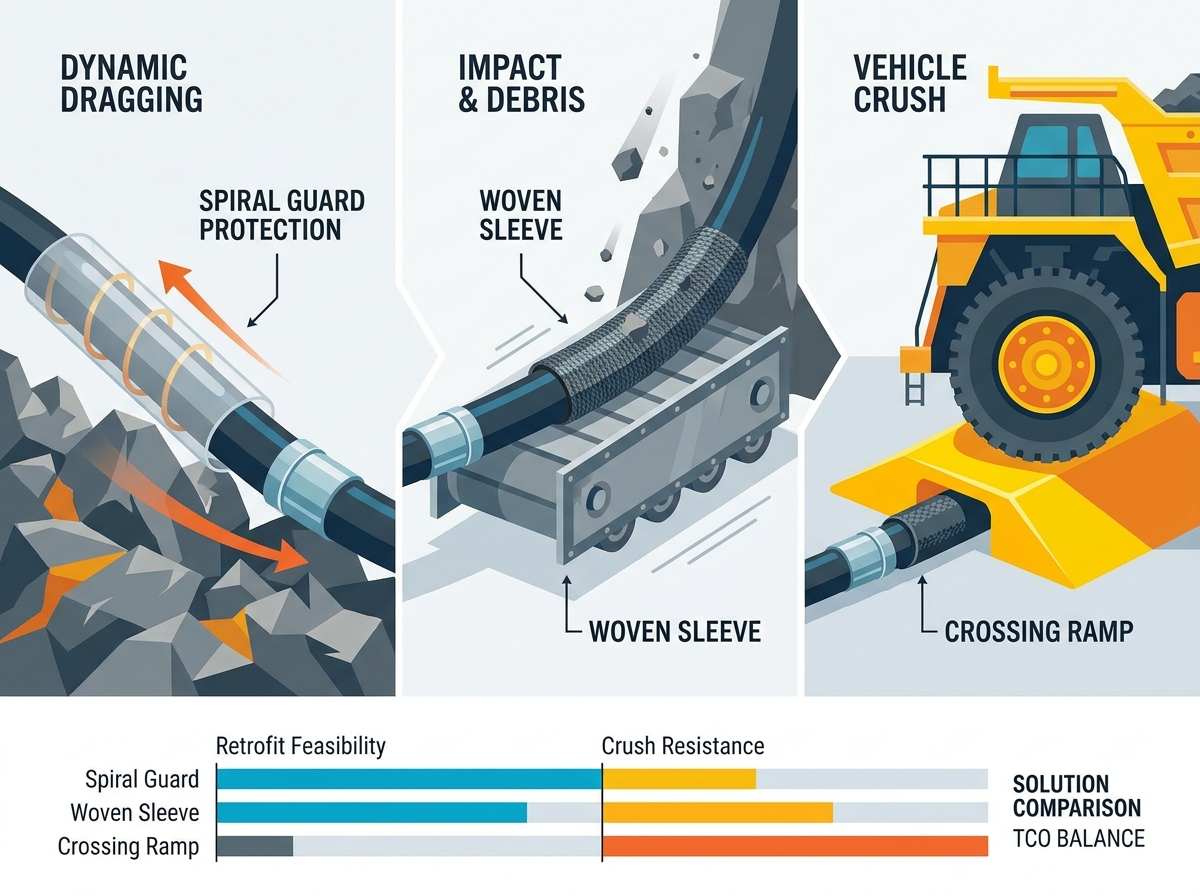
Exposed lines on the ground face intense physical punishment. Reliable hose crossing protection prevents catastrophic ruptures caused by vehicle traffic.
Heavy vehicle traffic presents a dual threat to fluid lines. Haul trucks and massive loaders generate immense downward pressure. When unprotected lines rest on the ground, this weight causes immediate catastrophic failure. Even if the line survives the initial pass, micro-fractures develop in the steel wire reinforcement. These invisible fractures weaken the structure significantly. Subsequent pressure spikes during operation will blow out the compromised section.
Surface-level drop-over ramps offer an excellent temporary solution. They utilize dense polyurethane to shield lines from rolling tires. You simply place them directly over the lines. They prove ideal for temporary operational zones. Drop-over ramps provide high visibility through bright safety colors. They also allow maintenance teams immediate physical access to the lines beneath. You can easily relocate them as the operational face moves.
Permanent high-traffic corridors require heavier infrastructure. Steel trenching bridges support immense loads safely. You must evaluate digging shallow routing trenches underneath the roadbed. Trenching protects lines entirely from surface activity. However, surface-level steel armor remains easier to inspect. You must decide based on how frequently the corridor shifts.
You must evaluate protective products against strict industry parameters. Haphazardly throwing sleeves onto equipment rarely yields long-term success. Careful selection guarantees both safety compliance and operational efficiency.
Safety regulations strictly govern underground material usage. You must verify synthetic sleeves and plastic guards carry MSHA IC-approval. This approval guarantees specific flame resistance capabilities. Protective materials must demonstrate self-extinguishing properties when exposed to fire. Utilizing non-compliant materials underground violates federal law. It also introduces severe fire propagation risks into the mine shaft. Always demand certification documentation from your suppliers.
Maintenance schedules dictate how you apply protection. You must consider installation logistics carefully.
Spiral wrap and split-sleeves: You can install these in the field easily. They wrap around the line without breaking the hydraulic circuit. This saves massive amounts of downtime.
Continuous tubular sleeving: This method requires total system shutdown. You must disconnect the line, slide the sleeve over, and re-crimp the fittings. This process makes tubular sleeving better suited for new OEM builds.
Fluid temperature management remains critical for system health. Thick, bundled abrasion sleeves often act as heavy insulation. They trap ambient heat around the lines. They also prevent natural cooling of the hydraulic fluid inside. You must assess whether this insulation will cause fluid to exceed safe operating temperatures. Overheated hydraulic fluid degrades rapidly. It damages internal pump seals and reduces system efficiency.
Installing protection represents only the first step. You must manage and maintain these barriers effectively. Poorly maintained guards can hide dangerous underlying issues.
Thick protective guards completely obscure the actual fluid line. You must acknowledge this significant inspection risk. Mechanics cannot easily spot minor weeping leaks. They cannot visually detect internal wire fatigue through a dark sleeve. You must establish strict inspection protocols. Technicians need to physically slide back sleeves during scheduled maintenance. They must inspect the underlying cover for hidden deterioration.
Gravity and vibration conspire against protective sleeves. Unsecured sleeves will gradually slide down the assembly during normal operation. This movement exposes critical bend radii to raw friction. You must ensure all sleeves and spiral guards are properly anchored. Use heavy-duty zip-ties or metal clamps at the fittings. Secure anchoring maintains the protective barrier exactly where you need it most.
Protective barriers act as sacrificial components. They will eventually wear out. You must define exact visual wear indicators for your maintenance team. For nylon sleeves, an exposed underlying weave signals end-of-life. For plastic spiral guards, dangerously thinning edges dictate immediate replacement. You must replace the protection before the underlying line becomes compromised. Waiting too long defeats the purpose of the barrier entirely.
Effective defense against extreme environmental wear requires a strategic approach. You must match the specific material—whether nylon, UHMWPE, or steel—to the exact environmental threat. Dynamic dragging demands rigid deflection, while vehicle crossings demand heavy load distribution.
Take immediate action by auditing your current equipment failure rates. Identify your primary high-wear zones through daily maintenance logs. Consult directly with trusted suppliers regarding MSHA-rated material options. Finally, prioritize retrofit-friendly solutions, like split-wrap guards, for your highest-downtime equipment. Protecting these vital fluid pathways ensures sustained production and safeguards your workforce.
A: It can, particularly if multiple high-pressure lines are bundled tightly together in a poorly ventilated area. The protective material acts as insulation, trapping generated heat. You must consider thermal derating factors and monitor fluid temperatures closely after installation.
A: Yes, spiral wrap is specifically designed to be wound onto active assemblies. You do not need to drain fluid or disconnect fittings. This makes it an ideal, rapid-deployment solution for field retrofits and emergency wear prevention.
A: Abrasion resistance prevents external damage caused by rubbing against sharp rocks. Burst protection utilizes tightly woven nylon to contain high-pressure fluid sprays. It specifically protects operators from injection injuries if the internal line suddenly ruptures.
A: In highly controlled environments, yes. However, in dynamic mining environments where shifting rocks and erratic equipment movement are inevitable, routing alone is insufficient. Relying solely on routing usually results in premature failure due to unexpected physical impacts.