
- All
- Product Name
- Product Keyword
- Product Model
- Product Summary
- Product Description
- Multi Field Search
 English
Views: 0 Author: Site Editor Publish Time: 2026-10-14 Origin: Site


A ruptured hose at the pump discharge point does not just halt water removal. It creates immediate flooding risks, severe safety hazards, and compounding unplanned downtime costs. When a blowout occurs here, millions of gallons of water can flood critical access tunnels within minutes. The connection point between a high-volume mine dewatering pump and the discharge line is extremely aggressive. It acts as the most hostile environment in the entire fluid transfer system. It bears the brunt of heavy mechanical vibration, maximum fluid velocity, and extreme pressure transients. We wrote this guide to deconstruct the specific root causes of these failures. You will gain an evidence-based framework for evaluating a replacement hose and understand critical installation realities. These insights will help you prevent repeat failures and ensure continuous, safe operations.
Root Causes: Most pump outlet failures stem from water hammer (surge), cavitation-induced vibration, or mismatched coupling systems, not just normal abrasive wear.
System Design: Upgrading to a premium hose is ineffective if pipeline misalignment and lack of mechanical anchoring are the true failure drivers.
Evaluation Criteria: Selecting the right replacement requires balancing burst pressure safety margins, cover material durability, and the integration of surge-absorbing expansion joints.
Total Cost of Ownership: Prioritize predictable maintenance cycles and engineered coupling retention over the lowest upfront unit cost to minimize operational disruptions.
Moving fluid from a rigid metal pump casing into a flexible conduit introduces immediate, localized stress. The pump generates aggressive mechanical forces through its rotating impeller. The flexible hose must absorb these forces constantly. This transition point forces a sudden change in material rigidity. A rigid steel pipe transfers vibration linearly along its length. A flexible rubber hose, however, absorbs it locally at the connection point. This absorption causes rapid material fatigue right at the flange, weakening the rubber bonds.
The pump outlet represents the absolute peak of hydrostatic and dynamic pressures within the system. Friction loss gradually reduces pressure further down the pipeline as the fluid travels. However, the first few feet of the discharge line face the full, unmitigated force of the impeller. Fluid exits the pump at maximum velocity and turbulence. Any sudden resistance creates an immediate, localized pressure spike. The inner tube of the hose must withstand this constant, punishing environment without deforming.
Slight misalignments between the pump flange and the rigid pipeline cause severe, compounding problems. They amplify lateral and torsional stress directly onto the first three feet of the flexible hose. If you install the hose at a slight angle or with an offset, the coupling constantly pulls against the internal reinforcement layers. This uneven tension weakens the overall structure. The hose will eventually tear near the fitting under heavy load, usually during a pressure surge.
Understanding the exact mechanics behind a mine dewatering hose pump outlet failure helps you prevent catastrophic downtime and protect your site.
Hydraulic shock occurs during rapid pump start-up, sudden valve closure, or unexpected power failure. Water in the pipeline rapidly changes momentum, creating a massive shockwave that travels back toward the pump. Pressure spikes can easily exceed the rated working pressure of the system by three to five times. This violent hydraulic shock causes catastrophic carcass rupture. You must anticipate pump surge hose damage when designing your pumping infrastructure. Standard industrial hoses simply blow out when subjected to these extreme multiplier forces.
Improper Net Positive Suction Head (NPSH) causes cavitation inside the pump casing. Cavitation bubbles form in low-pressure zones and then collapse violently as they enter high-pressure zones. This collapse sends aggressive, high-frequency vibrations directly through the pump casing and into the attached hose. Continuous vibration is highly destructive to layered materials. It steadily degrades the adhesion between the inner rubber tube, the textile reinforcement layers, and the outer protective cover. This process leads to internal delamination. Once delaminated, the hose quickly loses its structural integrity and bursts.
Using standard industrial couplings for high-volume mining applications introduces massive, unnecessary risk. Standard clamps and bands cannot handle extreme axial loads generated by heavy slurries. Coupling pull-off usually happens due to thermal expansion, pressure elongation, or aggressive vibration. Lack of external restraint systems makes this situation far worse. You should never rely solely on the external friction of a banded fitting to hold a mining hose. The extreme internal forces will eventually eject the coupling, causing a dangerous high-pressure water release that threatens nearby personnel.
Turbulent flow exiting the impeller aggressively scours the inner tube of the flexible hose. This abrasion accelerates rapidly if there is a sudden reduction in internal diameter (I.D.) at the fitting transition. The choke point forces the heavy slurry to speed up, increasing its kinetic energy. Abrasive particulates, like crushed quartz or iron ore, act like sandpaper against the rubber wall. Over time, this localized wear thins the tube completely until the high-pressure fluid breaches the reinforcement layers.
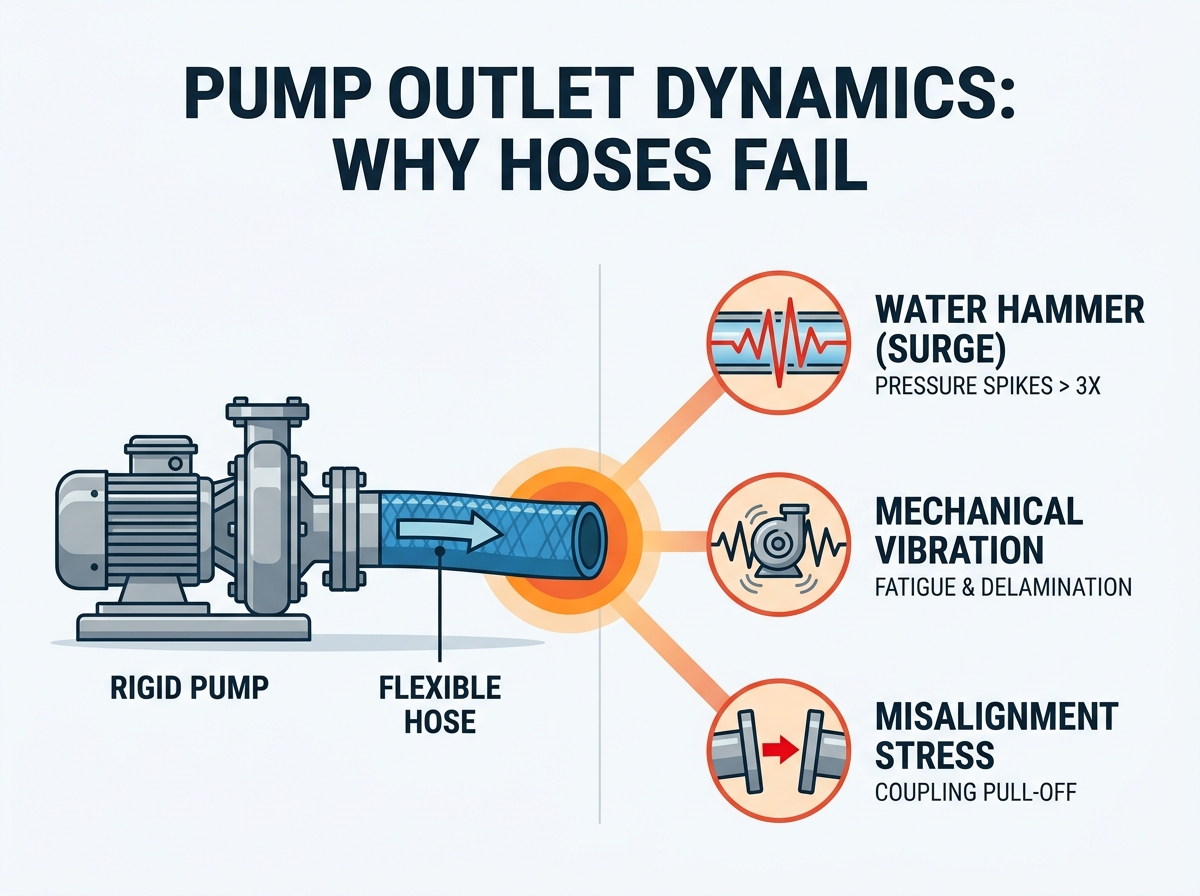
Choosing a resilient dewatering pump discharge hose demands strict engineering criteria. You cannot simply order a generic replacement without verifying its structural capabilities.
Do not buy replacement components based solely on the standard operating pressure. You must require a minimum 3:1 or 4:1 burst pressure safety factor. This critical margin accommodates inevitable surge events, valve closures, and system shocks. Request detailed manufacturer testing data specifically for cyclic pressure fatigue. Static burst tests do not tell the whole story, as they only measure peak failure once. Cyclic fatigue tests simulate real-world mining conditions much more accurately by pulsing the pressure thousands of times.
Evaluate hose materials based strictly on your specific fluid profile and site conditions. Different slurries require distinct chemical and mechanical approaches. Assess the reinforcement matrix based on the specific forces at play. High-tensile synthetic textiles work exceptionally well for standard positive discharge pressure applications. However, a heavy-duty steel wire helix becomes absolutely necessary if the hose must handle any suction forces, vacuum conditions, or extreme bending radiuses.
Material Application Guide
Material Type | Primary Strength | Ideal Mining Application | Common Limitation |
|---|---|---|---|
SBR / Natural Rubber | High mechanical abrasion resistance | Heavy slurry, rock, and sand transfer | Poor resistance to aggressive chemicals |
EPDM | Excellent chemical and heat resistance | Acid mine drainage, high-pH fluids | Lower resistance to sharp physical abrasion |
Nitrile (Buna-N) | Superior oil and hydrocarbon resistance | Water mixed with drilling oils or fuels | Higher baseline cost than standard SBR |
Transition away from banded or clamped fittings immediately. They present a major safety hazard in high-volume applications. Mandate internally expanded, built-in, or swaged vulcanized fittings. Engineered connections like fixed flanges, floating flanges, or heavy-duty Victaulic grooves eliminate leak paths. They also physically prevent coupling ejection under extreme operational loads.
Buying a premium hose only solves half the problem. Proper installation and pipeline anchoring dictate its actual service lifespan.
You must anchor the rigid pipe downstream properly before starting the pump. The flexible hose should never support the dead weight of the vertical or horizontal water column. Provide structural steel supports or concrete blocks to hold the rigid piping securely. Mandate the use of engineered safety restraints exactly at the pump outlet. Heavy-duty hose hobbles or engineered whip checks are absolutely critical. They physically secure the flange connection and prevent the heavy hose from whipping violently and injuring personnel if a blowout occurs.
We highly recommend integrating Variable Frequency Drives (VFDs) or electrical soft starters into your pump motor control systems. These devices ramp up the pump RPM gradually rather than slamming the fluid system with instant velocity. This gradual acceleration effectively eliminates destructive startup water hammer. It protects the entire discharge assembly, including valves and seals, from unnecessary hydraulic shock. VFDs also allow you to match pump output precisely to the required inflow rate.
Follow the straight-line rule religiously during installation. Ensure the hose runs completely straight for at least three to five times its internal diameter before introducing any bends or sweeps. This straight run allows turbulent, swirling flow exiting the pump impeller to settle into a smoother, laminar flow. It minimizes localized scouring on the inner rubber tube. It also prevents uneven mechanical stress on the flange connection, drastically extending the service life of the assembly.
Operators often select cheaper hoses to save upfront money. This approach ignores the devastating financial impact of an unexpected pipeline blowout.
When an outlet hose bursts, the financial damage extends far beyond the invoice price of a new rubber part. Consider this comprehensive formula for calculating true failure costs:
Calculate direct pump downtime hours multiplied by your hourly lost production value.
Add all emergency cleanup costs, including vacuum trucks and environmental mitigation expenses.
Add the actual replacement component costs and expedited freight fees.
Include the overtime labor hours required for emergency repair and system testing.
Compare the upfront premium of a custom-engineered discharge hose with built-in flanges against recurring replacement costs. Off-the-shelf industrial hoses might look attractive on a spreadsheet when evaluating initial expenditures. However, they heavily inflate your ongoing operational costs through constant replacements, unexpected failures, and emergency maintenance labor. Investing in engineered flanges and premium reinforcement materials dramatically lowers your operational expenses over a multi-year timeline.
Establish strict criteria for vendor selection before purchasing your next replacement hose.
Do they offer comprehensive site audits to measure alignment prior to specification?
Do they provide serial-numbered hoses ensuring full manufacturing traceability?
Can they produce verified cyclic pressure test certificates from an independent laboratory?
Your first action item should be an immediate, physical site audit. Inspect your current pump outlet installations for visual signs of cover stress or cracking. Look carefully for coupling slippage, weeping fluid, or excessive mechanical vibration. Identify these system weaknesses before specifying the new replacement.
Mine dewatering hose failures at the pump outlet are rarely random events or bad luck. They result predictably from mismatched system dynamics and inadequate component specification. Moving from a consumable mindset to an engineered-asset mindset for discharge hoses drastically improves site safety and operational uptime. Focus heavily on proper pipeline alignment, proactive surge prevention, and integrating built-in coupling systems. We advise operators to consult directly with experienced fluid transfer engineers. They can help you specify a highly durable hose system designed exactly for your unique pump curve and fluid profile. Take action today. Audit your high-pressure discharge zones, identify misalignment risks, and secure your critical pumping infrastructure before the next blowout occurs.
A: Lifespans vary wildly, ranging from three months to over three years. This depends heavily on slurry abrasiveness, fluid pH levels, and pressure cycling frequency. Establishing a predictable, scheduled replacement interval is much more important than pushing for absolute maximum longevity.
A: Never attempt to repair a high-pressure discharge hose. The structural integrity of the textile or steel reinforcement layers cannot be reliably restored. A repaired hose poses a severe safety hazard to personnel. Full replacement is strictly mandatory.
A: Look closely for localized bulging near the metal coupling. Watch for longitudinal tearing on the outer rubber cover or exposed reinforcement wire. If the hose physically "jumps" or thrashes violently during pump startup, surge damage is actively occurring.
A: The fitting acts as the transition zone between a rigid metal component and a flexible rubber one. It absorbs the most bending stress, extreme flow turbulence, and coupling-insertion friction. This intense concentration of forces makes it the natural weak point.