
- All
- Product Name
- Product Keyword
- Product Model
- Product Summary
- Product Description
- Multi Field Search
 English
Views: 0 Author: Site Editor Publish Time: 2026-11-22 Origin: Site


Handling large-diameter hoses manually presents a massive operational challenge on job sites. It consistently ranks as a primary source of ergonomic injuries and costly site delays across industrial sectors. You cannot manage this physical toll without relying on accurate math. The total calculation varies wildly because it depends on dry hose material, fluid density, coupling type, and exact internal diameter. Guessing these values leads directly to overworked crews, dropped lines, and dangerous chemical spills. We built this guide to give operators and procurement teams a concrete framework. You will learn exactly how to calculate the complete operational load before deployment. We also show you how to balance aggressive flow requirements against safe manual handling limits. By understanding these variables, you can protect your team while maintaining peak transfer speeds.
A 100-foot, 5-inch transfer hose filled with water routinely exceeds 900 pounds in total weight.
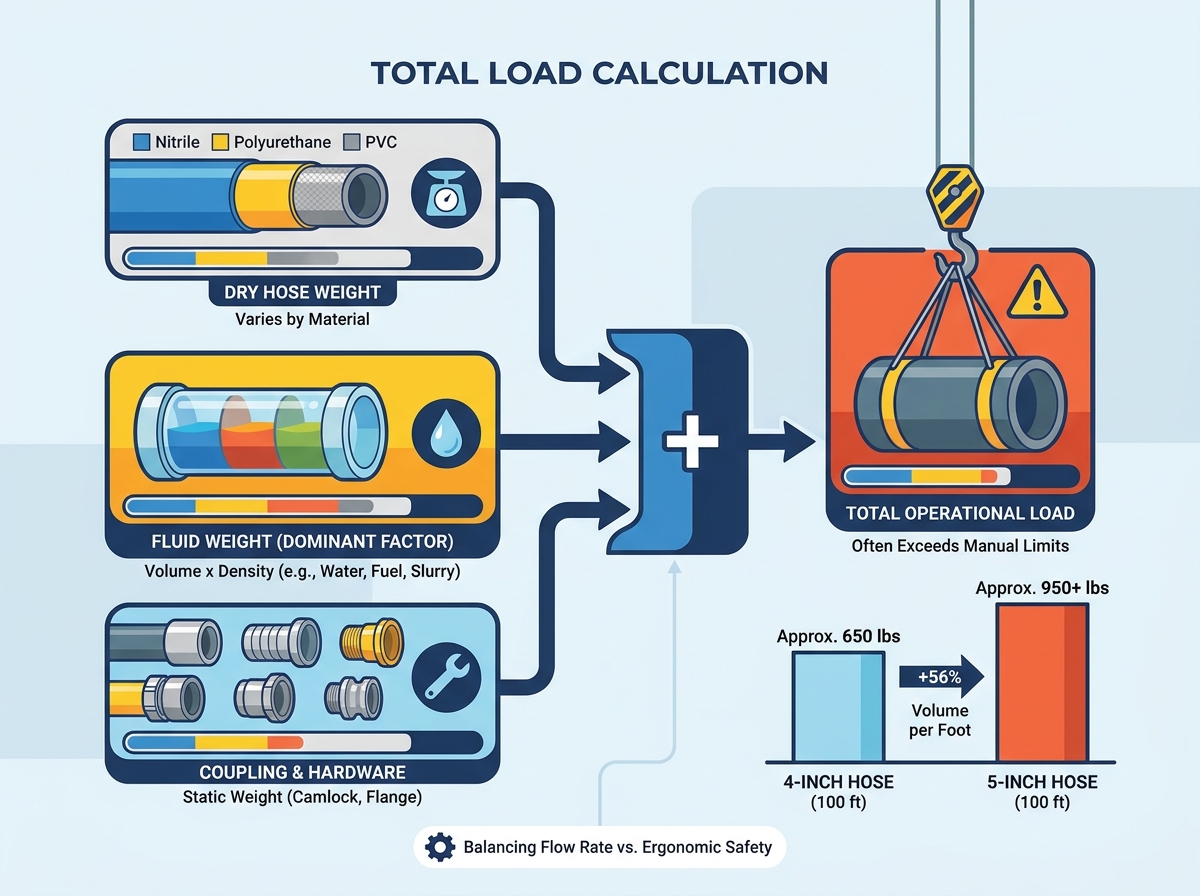
Total load calculations must account for three distinct variables: dry hose weight, specific fluid density, and coupling/hardware mass.
Upgrading to larger diameters drastically increases flow rates but exponentially increases water weight, often requiring mechanical lifting aids.
Selecting lighter coupling materials (e.g., aluminum over brass) and composite hose materials can marginally reduce dry weight, though fluid weight remains the dominant factor.
To find your exact filled transfer hose weight, you need a reliable mathematical equation. You cannot simply look at the dry weight listed on a manufacturer spec sheet. The active operational load demands a deeper breakdown.
First, consider the dry hose weight. This variable changes significantly based on material construction. Nitrile rubber behaves quite differently than extruded polyurethane or PVC. You must reference the exact technical data sheet for your product. Manufacturers usually list this specific metric in pounds per foot. Simply multiply this number by your total hose length.
Next, we look at the dominant variable: fluid weight. You must calculate the total internal volume first. Use the standard cylinder volume formula. You calculate total gallons based on the internal diameter and the overall length. A small increase in diameter creates a massive increase in internal volume.
Once you know the total gallons, apply the specific gravity of your target liquid. As a baseline reference, pure water weighs approximately 8.34 pounds per gallon. Refined petroleum products run lighter. Pumping gasoline or diesel yields a lower total weight. Conversely, heavy slurries, drilling muds, or caustic chemicals weigh significantly more.
Finally, factor in your hardware and fittings. You must include the static weight of all end connections, clamps, and shutoff valves.
Here is your complete calculation structure:
Determine the Total Dry Weight (Pounds per foot × Length).
Calculate Fluid Volume (Total gallons held inside the line).
Determine Fluid Weight (Volume × Specific fluid density).
Determine Coupling Weight (Mass of all attached hardware).
Add all three categories together (Dry Weight + Fluid Weight + Coupling Weight = Total Operational Load).
Common Mistake: Operators often forget to include the volume trapped inside rigid elbow joints and reducers. Always account for the entire fluid column from the truck valve to the receiving tank.
Operators frequently face the classic 4-inch versus 5-inch diameter dilemma. Upgrading size impacts the nonlinear relationship between diameter and volume drastically. A 5-inch hose holds roughly 56% more liquid per foot than a 4-inch hose. This physical reality changes your entire operational strategy.
This massive jump changes everything for a standard tank truck transfer hose. A filled 4-inch line might remain manageable for a coordinated two-person team. However, a filled 5-inch line demands a completely different approach. It requires highly coordinated team efforts. In many cases, it strictly requires mechanical assistance to move safely.
Next, we must weigh friction loss against physical deployment speed. Larger hoses reduce internal friction loss effectively. They speed up offloading times dramatically. A larger line means the pump works less to move more fluid. Yet, the severe weight penalty can slow down physical deployment. Physical retrieval also becomes a grueling, time-consuming task.
We need a practical decision matrix. You must map your required Gallons Per Minute (GPM) directly against the physical capabilities of your operational crew.
Transfer Hose Flow vs. Handling Matrix (Based on 100-foot length, Water)
Internal Diameter | Approx. Fluid Capacity | Approx. Fluid Weight | Manual Handling Difficulty |
|---|---|---|---|
3-Inch | 36 Gallons | 300 Lbs | Moderate (Manageable by 1-2 persons) |
4-Inch | 65 Gallons | 542 Lbs | Difficult (Requires trained team) |
5-Inch | 102 Gallons | 850 Lbs | Extreme (Mechanical aid highly recommended) |
6-Inch | 146 Gallons | 1,217 Lbs | Prohibitive (Requires cranes or boom arms) |
Hardware choices heavily influence your total operational load. You must evaluate standard industrial hardware options carefully before building your assembly. A minor change in metal type shifts the burden on your crew significantly.
Let us compare standard coupling materials found in industrial settings:
Aluminum: This remains the standard choice for weight reduction. It provides excellent mobility for rapid deployment. However, it proves susceptible to certain corrosive chemicals.
Stainless Steel: You need this material for food-grade operations or highly corrosive transfers. Be aware, it adds significant static weight directly at the ends of your assembly.
Brass: This material is highly durable and completely non-sparking. Unfortunately, it imposes the highest absolute weight penalty on your workers.
Connection types also dictate the final mass. Cam-and-Groove (often called Camlock) fittings usually weigh less than heavy-duty threaded flanges. Storz connections offer a solid middle ground. They provide quick deployment while keeping weight manageable.
Operator ergonomics suffer most at these connection points. Coupling weight concentrates entirely at the ends. This lever-arm effect creates massive torque on the human body. This reality makes initial connection and final disconnection the most physically taxing phases of any transfer operation.
Best Practice: Whenever operational parameters allow, use aluminum Camlock fittings for high-diameter lines. This choice reduces end-weight drastically and protects your workers' lower backs during the crucial connection phase.
We must frame hose handling against standard workplace lifting guidelines. OSHA strongly advises against exceeding specific manual lifting limits per person. National safety guidelines typically cap safe individual lifting around 50 pounds under ideal conditions. A single operator should never attempt to drag or reposition a fully charged 5-inch line alone. Doing so violates basic ergonomic safety principles immediately.
Ignoring these rules leads directly to common injury vectors. Workers frequently suffer severe lower back strains from improper lifting postures. They also face severe crush hazards from dropping heavy couplings onto their feet. Furthermore, wrestling charged lines on uneven terrain drastically increases slip-and-fall risks. Fluid shifting inside the line creates unpredictable momentum. This momentum easily throws off a worker's balance.
You can mitigate these dangers through intelligent site engineering solutions. Consider implementing the following support systems:
Deploy hose saddles to prevent dragging and kinking. Saddles distribute the load evenly.
Install ground rollers to ease physical repositioning across concrete or gravel.
Utilize mechanical boom arms to support the static weight during active loading phases.
Finally, you need strict standard operating procedures (SOPs). Mandate draining lines completely before initiating any movement. Gravity draining or mechanical pigging removes the heaviest variable from the equation entirely. Never allow crews to drag lines while they remain full of liquid.
Procurement teams must rethink how they define success criteria. They should not just look at burst pressure and purchase price. They must factor in the fully loaded weight for everyday operators. A cheap, heavy-walled rubber hose might save money upfront. However, it will cost the company significantly if it causes handling injuries.
Material innovations offer exciting new possibilities. Modern woven-jacket or extruded polyurethane hoses provide much lower dry weights. They also deliver tighter bend radii. You must evaluate whether these operational benefits justify their premium price over traditional rubber.
Standardization brings massive operational advantages. By standardizing hose diameters and coupling types across a fleet, you ensure predictable weight limits. Crews memorize uniform handling procedures faster. They know exactly how much physical effort a standard 4-inch assembly requires. This predictability prevents unexpected strain injuries.
As a next step, change your purchasing habits. Always advise buyers to request "wet weight" charts from manufacturers. Specify the exact chemicals you handle before finalizing any purchase order. A reputable manufacturer will gladly provide a matrix showing exactly how heavy their product gets when filled with your specific fluid.
The fluid itself dictates the vast majority of a filled hose's weight. Upgrading to advanced, lightweight materials only shaves off a fraction of the total operational load. You must respect the physics of fluid volume.
Finding the optimal transfer setup requires a deliberate, careful compromise. Your lines must remain large enough to meet demanding offloading efficiency targets. At the same time, they must stay small enough for your on-site crew to manage safely without risking injury.
Operations managers should always calculate the exact filled weight for their specific fluid and length. Run these numbers before rushing to upgrade your site to a larger diameter format. Plan your mechanical support systems accordingly.
A: A 4-inch hose holds approximately 65 gallons of water per 100 feet. Water weighs roughly 8.34 pounds per gallon. The water alone weighs about 542 pounds. When you add the dry hose material and the metal couplings, the total operational weight typically ranges from 620 to 680 pounds.
A: A standard 5-inch hose holds roughly 102 gallons of fluid per 100 feet. The water inside weighs about 850 pounds. Once you factor in the dry weight and heavy hardware, the total weight easily exceeds 950 to 1,000 pounds, requiring mechanical lifting aids.
A: Yes. Fluid weight depends entirely on specific gravity. Pumping diesel or gasoline results in a noticeably lighter total weight than pumping water. Conversely, pumping liquid mud, dense resin, or heavy chemicals results in a much heavier total operational load.
A: Yes. You can utilize composite hoses, lightweight polyurethane (TPU), and specialized lightweight EPDM blends. These advanced materials reduce the dry weight of the assembly and improve flexibility. However, they do not change the weight of the actual fluid trapped inside.