
- All
- Product Name
- Product Keyword
- Product Model
- Product Summary
- Product Description
- Multi Field Search
 English
Views: 0 Author: Site Editor Publish Time: 2026-11-03 Origin: Site


In mining and high-risk industrial environments, a failed air hose inspection doesn’t just cause operational downtime. It triggers severe MSHA citations and immediate safety hazards. Many suppliers heavily market their hoses as "mining ready" or "flame resistant." However, lacking an official Mine Safety and Health Administration (MSHA) approval number on the layline renders those claims completely irrelevant during an audit. Site operators face steep fines and stop-work orders if inspectors cannot verify the exact equipment credentials. This guide details how you can quickly decode layline markings and independently verify MSHA approval records. You will also learn how to evaluate procurement options for a compliant, heavy duty industrial air hose. By mastering these verification steps, safety managers can confidently secure job sites while avoiding costly regulatory penalties. We will break down exactly what inspectors look for. We will explain how to track material compounds. Finally, we provide actionable steps for auditing your current inventory to ensure absolute compliance.
Genuine MSHA approval requires a specific, traceable "IC" (Independent Contractor) or "Schedule" number permanently marked on the hose.
Buyers must independently cross-reference supplier claims against the official MSHA equipment approval database to ensure certificates are active.
Evaluating a heavy duty industrial air hose requires balancing MSHA flame-resistance mandates with abrasion resistance and operational pressure thresholds.
Procurement managers should mandate current MSHA certification documentation from manufacturers prior to finalizing bulk purchase agreements.
Operating with unapproved hoses in environments governed by Title 30 CFR (Code of Federal Regulations) exposes operations to massive risks. Inspectors possess the authority to issue immediate stop-work orders. They can also levy heavy financial penalties against site operators. Every minute of halted production translates to significant revenue loss. Ensuring equipment compliance is not just about safety. It is a critical aspect of protecting your business operations from sudden regulatory shutdowns.
Marketing claims often mislead procurement teams. Phrases like "flame retardant" or "fire safe" do not equal actual MSHA compliance. MSHA standards explicitly dictate the specific testing for flame resistance in underground and hazardous surface applications. You cannot rely on generic brochure terminology. The federal testing criteria ensure the hose cover will rapidly self-extinguish when removed from a direct flame. Standard industrial hoses will continue burning. They spread fire rapidly through confined underground spaces, endangering lives and equipment.
Inspectors actively look for visible, legible compliance markings during site visits. They walk the site inspecting hoses connected to pneumatic equipment. If the hose jacket degrades too quickly, the marking vanishes. This creates an immediate compliance violation. If the marking is counterfeit, the liability falls entirely on the site operator, not the distributor.
Common reasons for failed hose audits include:
Completely illegible layline text due to severe abrasion.
Generic "MSHA compliant" wording without a matching IC number.
Mismatched documentation during record checks.
Hoses showing exposed internal reinforcement layers.
A genuine MSHA approved air hose provides the documented assurance required to pass these strict regulatory audits. It proves you have invested in verified, tested safety equipment.
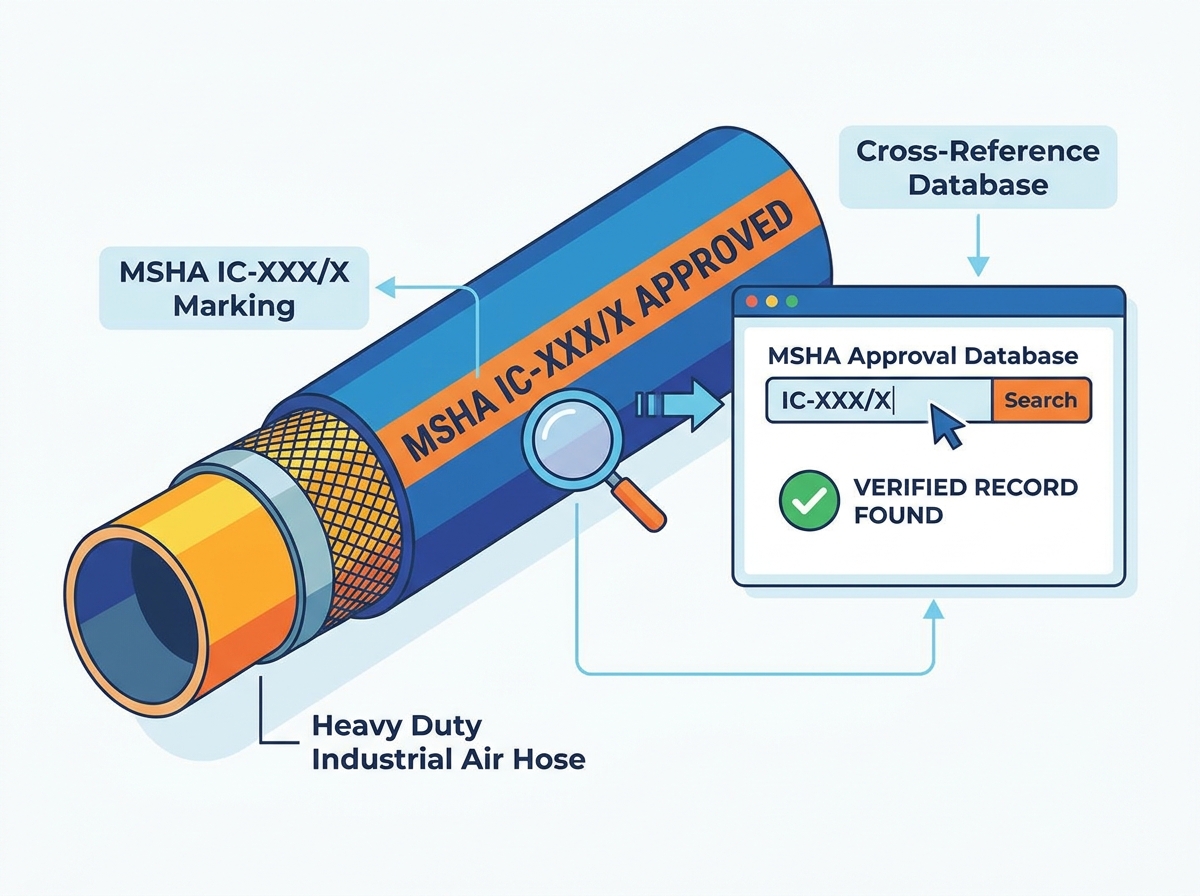
A proper MSHA marking follows a strict standard structure. You will typically see "MSHA IC-XXX/X" printed clearly along the hose layline. Understanding this code helps you verify authenticity instantly on the job site.
IC Number: This stands for Independent Contractor. It represents the specific material compound approved by MSHA.
Extension/Revision: The number following the slash indicates specific revisions. It may also denote additional approved compounds under the primary certification umbrella.
Layline wear presents a practical challenge in underground operations. Workers constantly drag hoses over jagged rocks, metal grating, and rough terrain. A heavy duty industrial air hose must utilize robust cover materials. Manufacturers often use chloroprene or specially formulated thick nitrile blends. These tough covers ensure the MSHA stamp survives repeated dragging. Some advanced hoses feature embossed or branded markings. These physical indentations remain readable even when surface ink fades away entirely.
Watch out for suspicious markings during your initial receiving inspection. Reject hoses bearing simple adhesive stickers. Avoid products featuring easily rubbed-off ink. Generic "MSHA Compliant" text without a corresponding IC number is a major red flag. It strongly indicates counterfeit or uncertified goods. An inspector will instantly flag these during a walk-through. Always demand permanent, deeply printed, or embossed layline data from your manufacturers.
You must actively verify the IC number provided by your supplier. Use the official MSHA online equipment approval database. You can also utilize FOIA reading rooms to confirm an IC number history. Enter the number exactly as it appears on the hose cover. The database will return the status of that specific material compound. It will confirm if the certification remains active and valid.
The implementation reality often confuses procurement teams. A hose manufacturer frequently buys an MSHA-approved cover compound from a third-party chemical supplier. The IC number technically belongs to the chemical compound formulation. It does not always belong to the hose brand you purchase from the distributor.
Buyers must follow strict verification logic to close this knowledge gap. Request a formal "Letter of Authorization." This document connects the hose manufacturer directly to the supplier of the MSHA-approved compound. It proves the manufacturer legally utilizes the certified material. Without this letter, you cannot definitively link the hose brand to the federal approval record.
What happens if an IC number returns a different company name? This often occurs due to corporate acquisitions or rebranding. Do not panic, but do not ignore it. You must request updated documentation from your distributor. Ask for a formal letter explaining the name change or corporate transfer. Inspectors will demand a clear paper trail during an audit. This trail must prove the current manufacturer legally utilizes the certified compound listed on the hose layline.
MSHA certification focuses narrowly on specific safety metrics. They only certify flame resistance and self-extinguishing properties. The agency does not test operational pressure ratings. They do not certify overall hose longevity, flexibility, or weather resistance. You must evaluate these operational factors independently to ensure site productivity remains high.
A reliable heavy duty industrial air hose must feature a high-visibility cover. It needs an ozone-resistant outer layer to withstand severe environmental degradation. Ultraviolet light and extreme temperatures break down inferior rubber quickly. A robust design prevents early replacement cycles in harsh outdoor climates. High visibility colors like bright yellow or red help prevent tripping hazards in dimly lit underground tunnels.
High-tensile synthetic yarn is necessary for standard pneumatic operations. Wire-braid reinforcement provides even greater strength for heavy-duty applications. These internal reinforcement layers prevent dangerous bursts when operating high PSI pneumatic tools. If a hose bursts near a worker, the sudden whipping action can cause severe injuries. Strong reinforcement is non-negotiable.
MSHA-approved hoses generally cost more upfront than standard unrated hoses. Rigorous material testing drives up this initial price. Chemical additives required for self-extinguishing properties also increase manufacturing expenses. However, they yield substantial operational savings over time. They prevent massive regulatory fines. They also reduce hazardous premature failures. Investing in compliant equipment is a foundational risk management strategy for any serious operation.
Table: Core Differences Between Hose Specifications
Specification Metric | Standard Air Hose | MSHA Approved Air Hose |
|---|---|---|
Cover Material | Basic EPDM or SBR rubber | Flame-resistant synthetic rubber (e.g., Chloroprene) |
Self-Extinguishing | No guarantee | Strictly tested and verified |
Regulatory Standing | Non-compliant for underground mining | Meets Title 30 CFR requirements |
Layline Marking | Brand and PSI rating only | Brand, PSI, and official IC Number |
Procurement requires careful vendor selection to ensure long-term compliance. Only shortlist suppliers who proactively provide valid compliance data. They must supply date-stamped MSHA certification PDFs upon request. These documents must match their current product lines perfectly. Ask potential vendors about their internal quality control processes. Ensure they batch-test their hoses for consistency before shipping.
Mixing MSHA and non-MSHA hoses in the same storage facility creates massive implementation risk. Maintenance teams work quickly under pressure. They might grab the wrong hose during an emergency repair. We strongly recommend color-coding your inventory shelves. Use distinct SKU tagging to prevent accidental deployment of unapproved hoses into restricted underground zones. Separate the compliant hoses into locked cages if necessary to enforce strict inventory control.
Genuine MSHA markings do not guarantee infinite lifespans. Daily wear and tear degrade even the best equipment. Even a genuine MSHA approved air hose must be retired under certain conditions. You must train your teams to spot early signs of failure.
Implement this daily inspection checklist:
Check the layline for a fully visible and legible IC number.
Inspect the outer cover for deep abrasions, gouges, or deep cuts.
Examine the metal fittings for signs of slippage or leaking air.
Verify the internal reinforcement layer remains fully concealed under the cover.
Pull the hose from service if the jacket is breached. Retire it immediately if the reinforcement layer becomes exposed. You must also replace it if the IC number becomes completely illegible. You cannot prove compliance if the inspector cannot read the code.
Verifying an MSHA-approved hose requires moving past glossy sales brochures. You must validate the exact IC number via official records and authorization documents. Evaluating a hose means balancing necessary flame resistance with overall durability and pressure ratings. Do not assume compliance based purely on marketing jargon. Safety and compliance depend entirely on rigorous, independent verification.
Procurement teams should audit current hose inventory immediately. Check for legible IC numbers on all active pneumatic lines. Separate any hoses missing proper identification. Request updated compliance certificates from your distributors before your next scheduled site inspection. Implement strict SKU tagging for all new inventory arrivals. Proactive documentation prevents citations, protects operational revenue, and ultimately keeps your workforce safe.
A: Focus on the location distinction. Underground environments and hazardous locations strictly mandate flame-resistant MSHA approval under 30 CFR. Certain non-hazardous surface applications might not legally require it. However, standardizing MSHA-approved hoses across the entire site prevents accidental mixing and remains a much safer operational practice.
A: The approval itself doesn't typically "expire" unless officially revoked by the agency. However, manufacturers must re-certify their products if they alter the chemical composition of the hose cover. Always request recent authorization letters to confirm the current cover compound remains fully compliant.
A: Standard industrial hoses prioritize high pressure tolerance and abrasion resistance. They lack the specific self-extinguishing chemical compounds required for underground use. MSHA rigorously tests and certifies these specific compounds to prevent dangerous fire propagation in confined spaces.