
- All
- Product Name
- Product Keyword
- Product Model
- Product Summary
- Product Description
- Multi Field Search
 English
Views: 0 Author: Site Editor Publish Time: 2026-11-19 Origin: Site


Reinforced Thermoplastic Pipe (RTP) offers significant advantages in installation speed and corrosion resistance for gas gathering and distribution. However, it introduces distinct operational risks unlike those found in steel pipelines. Chief among these risks are gas permeation and rapid decompression.
Vendor specification sheets frequently emphasize burst pressure and tensile strength. They often minimize long-term permeation rates and the structural risks of emergency blowdowns. Procuring these pipelines without rigorous testing data exposes operators to severe consequences. These include compliance violations, environmental hazards, and catastrophic liner collapse.
We aim to equip pipeline engineers and procurement teams with a strict evaluation framework. You will learn to scrutinize manufacturer claims by focusing on exact test data, material limitations, and field-implementation realities. This validates the pipeline for safe, high-pressure gas service.
Gas molecules will naturally migrate through polymer chains under high pressure. You cannot completely stop this physical process. Instead, you must accurately calculate and manage the permeated volume. Acknowledging this reality is the first step in responsible pipeline design. Managing RTP pipe gas permeation requires engineered venting and continuous monitoring. You evaluate manufacturers based on their ability to quantify these permeation volumes reliably.
Ignoring permeation data leads to cascading failures in the field. Procurement teams must understand the exact risks involved.
You must scrutinize vendor claims during the bidding process. Dismiss any vendor who fails to differentiate between "leakage" and "permeation." Leakage indicates a manufacturing defect. Permeation represents a fundamental material characteristic. Furthermore, avoid manufacturers extrapolating low-pressure water data for high-pressure gas applications. Gas diffuses fundamentally differently than liquid water. Accepting water-based data guarantees operational failure in a live gas line.
Temperature dictates diffusion rates. Permeation increases exponentially as temperatures rise. A linear extrapolation will grossly underestimate actual gas flow at higher temperatures. You must request data showing permeation rates across your full operational temperature spectrum. Require plotted curves based on the Arrhenius equation. This confirms the polymer behaves predictably under peak summer heat or high-temperature compressor discharges.
Pipelines transport complex gas mixtures, not just pure methane. Different molecules permeate polymer matrices at different speeds. You must demand precise data sets for your exact application.
Short-term data misleads engineers. Reject any 24-hour extrapolated data outright. Polymers require time to reach steady-state permeation saturation. Request steady-state data derived from extended testing periods. A minimum of 30 to 90 days reflects actual field conditions. Anything less represents a transient phase and underestimates long-term venting requirements.
Internal vendor data lacks objective credibility. Specify requirements for independent validation. Permeation data must come from certified laboratories. These labs must utilize recognized testing apparatuses, such as precision manometric or volumetric methods. Third-party testing removes bias and ensures adherence to strict ISO or ASTM testing methodologies.
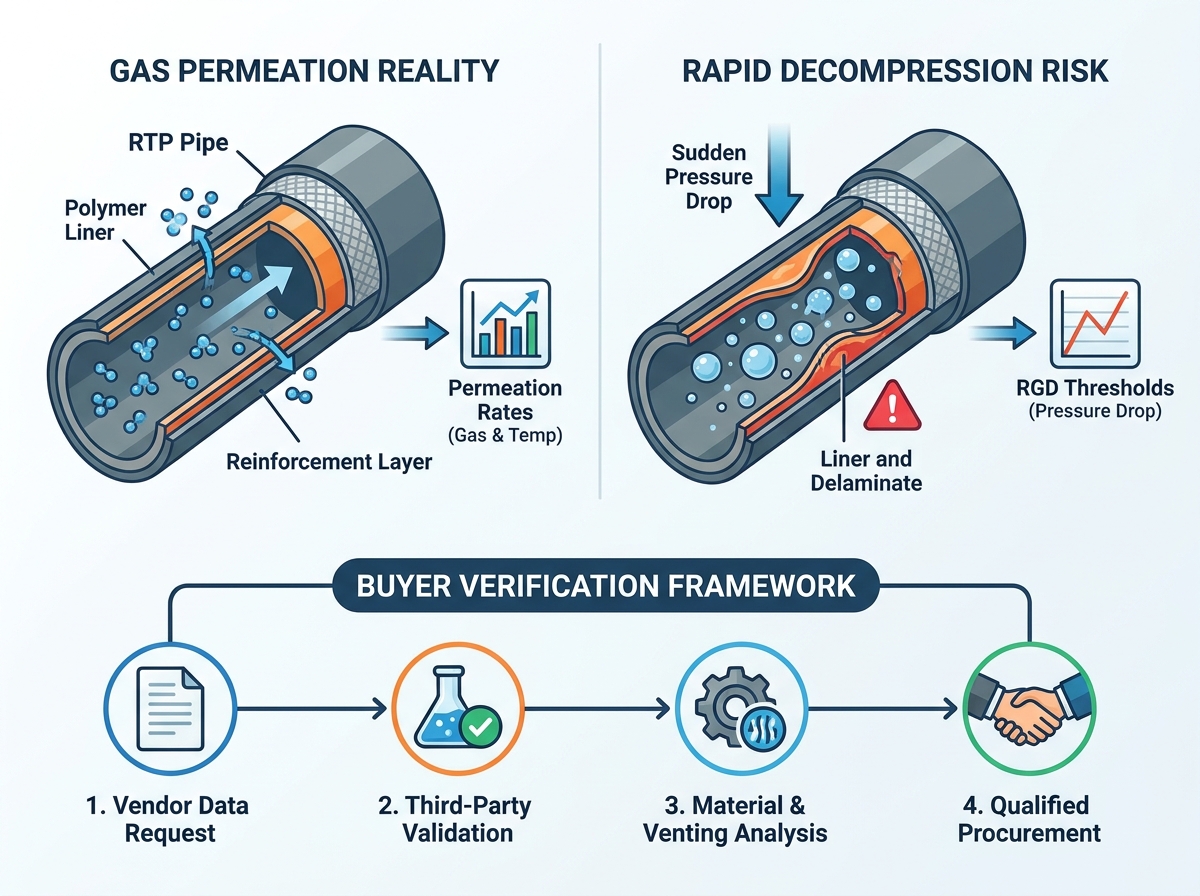
During normal operations, high pressure forces gas into the polymer liner. When an emergency blowdown occurs, pipeline pressure drops instantly. The gas trapped inside the liner cannot escape fast enough. It expands rapidly within the polymer matrix. If the decompression rate exceeds the material's off-gassing capacity, catastrophic failure occurs. The expanding gas causes severe blistering. It delaminates the inner liner from the reinforcement layer. In severe cases, it triggers complete inward liner collapse, blocking the flow path permanently.
Protecting your infrastructure requires stringent technical thresholds. Include these specific requirements in your procurement tenders.
Do not accept verbal assurances. Ask for microscopic cross-section imaging of the liner after RGD testing. Independent labs should slice the test pipe and examine the polymer matrix. This visual evidence verifies the absence of dangerous micro-voids, internal cracking, or surface blistering. Only pristine cross-sections guarantee safe field performance.
HDPE offers a highly cost-effective solution for many operators. However, it exhibits higher permeation rates compared to advanced polymers. You must request data verifying its suitability. Generally, engineers restrict HDPE to lower-pressure applications or completely sweet gas environments. Using HDPE in high-pressure sour gas lines invites rapid degradation and excessive venting volumes.
Polyamides provide a significantly stronger barrier to permeation than HDPE. They also offer excellent resistance to hydrocarbon liquids. This makes them ideal for mixed-phase gathering lines. However, they possess a unique vulnerability. Polyamides absorb moisture. You must request precise data on moisture absorption rates. High moisture content can plasticize the polymer, subtly altering its mechanical strength over time.
PVDF serves as the premier barrier for highly aggressive sour gas. It withstands extreme temperatures and resists chemical attacks flawlessly. Naturally, this performance commands a premium price. You must demand robust lifecycle analysis data to justify the initial capital expenditure over PE or PA alternatives. When dealing with lethal $H_2S$ concentrations, PVDF often becomes the only viable choice for a secure RTP pipe system.
Selecting the right liner requires balancing performance against project constraints. Use the following matrix to guide your procurement strategy.
Table: Polymer Liner Decision Matrix
| Polymer Type | Primary Application | Permeation Barrier Quality | Venting Complexity | CapEx Level |
|---|---|---|---|---|
| HDPE | Sweet gas, Low/Med pressure | Low | High (Frequent venting) | Low |
| PA11 / PA12 | Mixed hydrocarbons, Med pressure | Medium | Moderate | Medium |
| PVDF | Sour gas, High pressure/temp | High | Low (Minimal venting) | High |
Selecting the pipe solves only half the problem. You must physically manage the permeated gas. Request detailed engineering schematics for end-fitting vents. Furthermore, ask for designs covering mid-line venting ports for long pipeline runs. Ask vendors for hard data detailing maximum allowable venting distances. These calculations rely entirely on the specified pipe's permeation rate and available annular volume. Exceeding these distances causes pressure buildup and eventual liner rupture.
Permeation complicates pipeline monitoring. You must distinguish normal off-gassing from a catastrophic failure. Inquire how vendor-specified rates interact with your advanced monitoring tech. For example, systems using Dual-Tree Complex Wavelet Transform algorithms for acoustic sensors need baseline calibration. Establish clear thresholds. This ensures operators correctly differentiate normal permeated gas venting from a localized pipeline rupture.
Regulators increasingly scrutinize non-metallic pipeline installations. Request comprehensive documentation verifying the pipe meets stringent local safety assessments. Your vendor should provide environmental impact data aligning with regional frameworks. This includes mandates similar to PA DEP Chapter 105. Having vendor-supplied compliance data accelerates project permitting and protects operators during audits.
Streamline your procurement process by enforcing strict disqualification criteria. Use this simple checklist before reviewing commercial terms.
Once you filter the initial proposals, initiate a technical alignment meeting with the top two vendors. Refuse to review basic marketing brochures. Instead, demand a raw test data review. Require the vendor's lead materials engineer to attend this meeting. This ensures you receive technical facts rather than sales rhetoric. Scrutinize their laboratory methods and confirm their data aligns perfectly with your field conditions.
Sourcing thermoplastic pipelines for gas service requires moving far past basic pressure ratings. The true measure of a manufacturer's capability lies in their transparency regarding gas permeation physics. It also depends on their empirical data proving rapid decompression survivability. Relying on extrapolated water data or short-term testing courts disaster in live gas environments.
Treat permeation and decompression data as primary commercial evaluation criteria. Disqualify vendors unable to provide comprehensive, gas-specific testing data from high-pressure gas tenders. Enforcing these technical standards protects asset integrity. It prevents environmental violations. Most importantly, it ensures long-term operational safety across your entire gathering network.
A: There is no universal "acceptable" rate. It depends entirely on the polymer liner (HDPE vs. PA vs. PVDF), the gas composition, and operating temperature. Furthermore, the capacity of the pipeline's annular venting infrastructure to safely evacuate the permeated gas without pressure buildup determines the acceptable limit for your specific project.
A: Permeation is highly temperature-dependent. As the operating temperature increases, the free volume within the polymer matrix expands. This exponentially increases the rate at which gas molecules diffuse through the liner. Buyers must request permeation data explicitly mapped to their pipeline's maximum expected operating temperature.
A: Yes. If the pipeline experiences a sudden pressure drop, like an emergency blowdown, gas trapped within the polymer liner expands rapidly. If the decompression rate exceeds the pipe's specific rating, it causes the liner to blister. It can delaminate from the reinforcement layer or collapse inwardly, requiring immediate pipe replacement.