
- All
- Product Name
- Product Keyword
- Product Model
- Product Summary
- Product Description
- Multi Field Search
 English
Views: 0 Author: Site Editor Publish Time: 2026-11-15 Origin: Site


Shutting down a slurry-handling system without an adequate purging cycle guarantees solid settlement. You leave heavy particulate suspended in static fluid. Gravity quickly takes over. Heavy solids fall to the pipe floor immediately. Restarting against a plugged line creates immense pressure spikes. It can lead to catastrophic pump failure, hose rupture, or severe safety hazards on your site. Dealing with a slurry hose blockage after shutdown requires a systematic diagnostic approach. You cannot simply force the pump to overcome the obstruction. Doing so risks explosive pressure releases. This article provides a step-by-step pre-restart inspection framework. You will learn how to identify blockages accurately. We will show you how to safely clear them without damaging equipment. We will also help you evaluate whether your current infrastructure requires an upgrade. By following these guidelines, operators protect expensive equipment and maintain site safety.
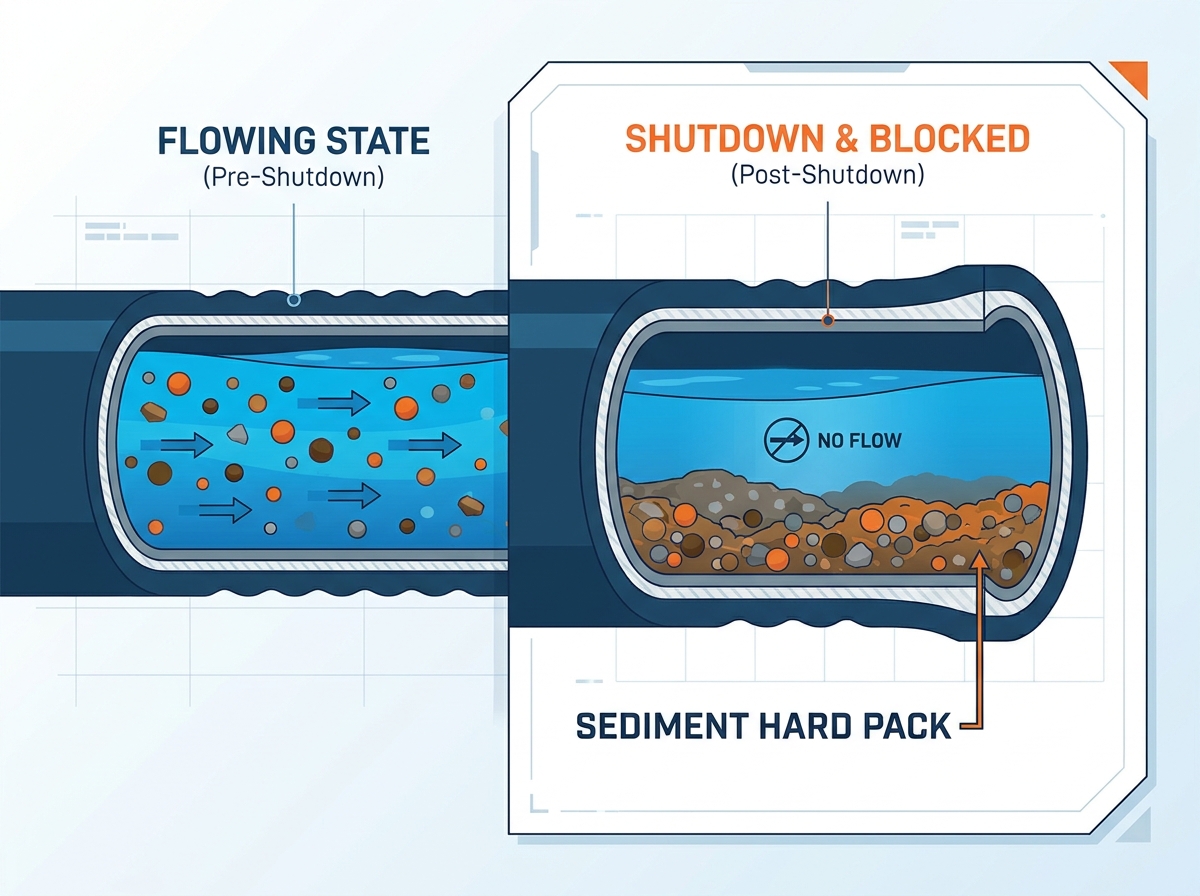
Solids drop out of suspension the moment flow stops. Fluid velocity dictates particle suspension capability. Heavier, denser particles fall faster than fine particles. Sudden flow loss removes the kinetic energy keeping these solids moving. Gravity pulls them directly to the bottom of the pipe. They accumulate rapidly in low-lying areas.
Fine particles act as a strong binder around coarse aggregates. The fines fill the void spaces between the larger coarse particles. This eliminates water pathways and creates a dense matrix. When flow stops entirely, this mixture consolidates rapidly. We call this the "hard pack." It turns a temporary settlement into a solid, concrete-like plug. Moisture drains away through microscopic gaps, leaving an immovable mass. You cannot push this mass out using normal pump startup pressure. The friction against the hose wall becomes far too great.
An improper restart carries heavy operational costs. Dead-heading a pump against a solid plug causes extreme heat buildup inside the casing. Mechanical seals blow out rapidly under the sudden pressure spike. Unplanned downtime extends from hours to days. You also face environmental spill compliance risks if a line ruptures. Safety liabilities multiply when pressurized lines burst near personnel. Workers standing nearby face extreme danger from whipping hoses and flying debris.
Operators must establish a strict pre-startup routine. Physical checks reveal what gauges cannot see. Start by walking the entire line. Look closely for unnatural sagging along flexible sections. Excess retained weight indicates settled solids inside. Perform the tap test using a non-metallic mallet. Tap the hose gently along its length. A hollow resonance means a clear pipe. A dull thud confirms a blockage. Check the exterior for any bulging or deformation. These signs point to internal stress or trapped material.
You must inspect both ends of your pumping system carefully. Blockages on the suction side starve the pump of fluid. This leads to immediate and damaging cavitation upon restart. Inspect suction isolation valves thoroughly. Check all flexible connectors for unnatural rigidity. A stiff suction hose usually means it contains compacted sand or ore.
The discharge side presents different challenges entirely. Identify the lowest points in your pipeline routing. Solids naturally accumulate at these elevations due to gravity. Bends, elbows, and long horizontal runs pose the highest risk. Inspecting the slurry suction and discharge hose ensures you catch blockages before energizing the system. Some modern facilities use thermal imaging cameras. These cameras spot cold areas representing solid plugs against warmer fluid sections.
Confirm all instrumentation functions correctly. Check pressure gauges, isolation valves, and drain points. They must be completely clear of compacted mud. Compacted material inside a gauge gives false zero-pressure readings. Clear these lines before introducing any start-up pressure. Operators rely on these readings to keep the system safe. Faulty gauges lead to disastrous decisions during startup.
Finding a plug means halting the restart immediately. Follow strict energy isolation protocols. Ensure the system holds zero stored energy. Depressurize the line fully before attempting to break a blockage. Trapped kinetic energy causes violent hose whipping if released suddenly. Lock out and tag out all associated pumps. Verify isolation valves remain tightly closed.
Backflushing offers the safest initial clearing method. Introduce high-pressure water from the discharge end in reverse flow. This reverse action gently erodes the blockage face. Monitor the backflush pressure closely. Never exceed the maximum working pressure of your hoses. Slowly washing away the solids prevents sudden hose ruptures. Keep the drain valves open to let the slurry escape safely.
Sometimes backflushing fails against a severe hard pack. You must resort to mechanical intervention. Isolate the affected section completely. Drain any residual fluid legally and safely. Dismantle the blocked hose section for manual clearing. Use approved cleaning tools designed for rubber-lined hoses. Standard industrial practices dictate using soft-edged tools for this process.
Never use localized heat on a blocked hose. Heat damages the rubber lining and causes rapid degradation. Do not strike the hose with sharp or heavy implements. Blunt force destroys internal wire reinforcement. Never bypass pump safety interlocks to force the plug. Doing so guarantees equipment failure and endangers lives. Ensure crews wear proper personal protective equipment during these tasks.
Standard flush cycles should prevent most blockages. If blockages occur frequently anyway, reconsider your existing hose specifications. Your current setup likely fails your specific operational reality. Hoses designed for water cannot handle abrasive, heavy slurries effectively.
Oversized hoses reduce internal fluid velocity. Fluid speed drops below the critical carrying limit. This encourages rapid and continuous settling of heavy solids. Correct dimensional sizing maintains optimal velocity. It keeps particles suspended even during minor flow fluctuations. Consult engineering guidelines to find the critical settling velocity for your specific slurry. Size your hoses to exceed this velocity by a safe margin.
Material selection dictates wear resistance and friction. Natural rubber and polyurethane offer lower friction coefficients. These smooth inner tubes allow easier flushing of settled solids. Abrasive particles slide along the liner instead of embedding into it. Harder materials might resist impact better, but they often increase friction. Evaluate your specific gravity and particle sharpness before choosing a liner.
Evaluate the flexibility of your current setup. Installing flanged, ultra-flexible hoses drastically improves maintenance readiness. Crews can drop, clear, and re-install them easily. They require less specialized heavy lifting equipment. This reduces downtime and significantly boosts your return on investment. Flexible hoses also absorb pump vibration better than rigid steel pipes.
Preventing blockages requires engineered solutions, not operator guesswork. Establish mandatory purge times for every shutdown. Calculate these flush durations based on pipeline length and fluid velocity. Factor in the specific gravity of your heaviest pumped solids. Stop relying on estimated clearing times. Document these procedures clearly in your operational manuals. Enforce them rigidly across all shifts.
Implement continuous differential pressure monitoring across the pump. Pressure drops signal early buildup inside the lines. This condition monitoring catches signs of a blockage forming. Early detection allows operators to initiate a flush before a hard pack develops. Install reliable sensors at strategic points along the pipeline. Calibrate them regularly to ensure accurate readings.
Sudden power losses remove your ability to flush lines. You must establish robust emergency shutdown plans. Create a protocol for immediate manual intervention. Operators should manually open the lowest-point drain valves immediately. Draining the slurry before it settles prevents catastrophic hard packing during blackouts. Train your team extensively on these emergency response procedures.
Slurry Hose Flush Time Calculation Factors
| Factor | Impact on Flush Duration | Recommended Action |
|---|---|---|
| Pipeline Length | Longer lines require extended flushing to clear all solids. | Calculate total volume and match flush pump flow rate. |
| Solid Density (SG) | Heavier solids settle faster during pump coast-down. | Increase flush velocity to ensure heavy particle suspension. |
| Hose Diameter | Larger diameters slow fluid velocity, increasing settling risk. | Maintain minimum transport velocity through correct sizing. |
| Elevation Changes | Vertical runs trap solids quickly when kinetic energy drops. | Install dedicated dump valves at the base of vertical climbs. |
Restarting a slurry system is high-stakes work. Bypassing physical checks of the slurry hoses risks safety and profitability. Small shortcuts during startup lead to massive mechanical failures. Hard packed solids destroy pumps and rupture expensive lines. Systematic diagnostics prevent these expensive disasters. Regular inspections save immense amounts of money and time.
Take immediate action to improve your procedures. Audit your current shutdown standard operating procedures today. Consult a hose manufacturer to audit your pipe diameters. Match your material liners to your specific gravity demands. Implement automated flush cycles where possible. Proactive inspections keep your operations safe, efficient, and running smoothly.
A: Highly variable based on particle size and density. Heavy metallic ores can drop out in seconds, while fine tailings may take hours.
A: Absolutely not. This causes pump dead-heading, heat buildup, and potential explosive rupture of the hose. Pressure must be cleared mechanically or via reverse flushing.
A: Yes. Suction hoses are internally wire-reinforced to prevent collapse under vacuum and may mask the physical weight of blockages, whereas discharge hoses endure higher pressures and typically block at the lowest elevation points or elbows.