
- All
- Product Name
- Product Keyword
- Product Model
- Product Summary
- Product Description
- Multi Field Search
 English
Views: 0 Author: Site Editor Publish Time: 2026-11-26 Origin: Site


A hose’s lifespan begins the moment it is manufactured. It does not start the day you install it on the factory floor. Every minute it sits on a warehouse shelf, chemical and physical changes are already underway.
Misunderstanding the distinction between storage longevity and operational endurance creates severe blind spots. Facility teams often deploy unused inventory only to experience premature assembly failures. These sudden ruptures lead to unplanned downtime and create severe safety hazards for your workforce.
This guide will equip maintenance, procurement, and facility managers with exact frameworks to evaluate inventory health. We will explore how to enforce strict storage compliance and vet suppliers based on material traceability. You will learn exactly what to record before placing any assembly into active service.
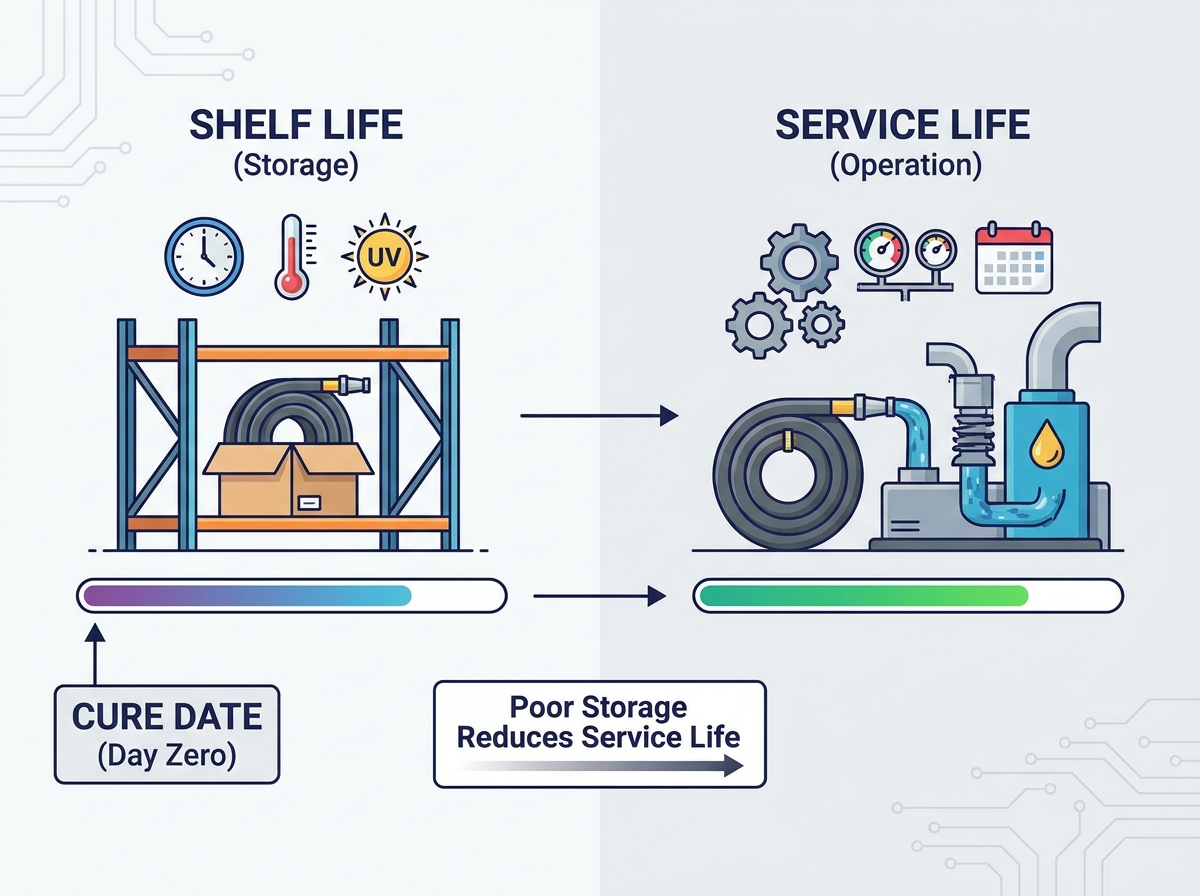
You must establish a firm baseline to manage inventory safely. We define shelf life as the maximum period you can store a hose without compromising its physical properties. It represents the countdown before materials degrade past acceptable performance thresholds. This duration varies heavily depending on the chemical compound. Natural rubber behaves differently than polytetrafluoroethylene (PTFE) or modern thermoplastics. Some materials degrade naturally over time, while others remain stable for decades under strict conditions.
Service life operates on a completely different metric. We define service life as the operational duration of the assembly once you install it. This phase introduces dynamic stressors. Pressure spikes, abrasive chemicals, continuous flexing, and environmental debris constantly attack the exterior and interior layers. A component only enters its service life once it begins performing its intended industrial application.
Understanding industrial hose shelf life vs service life reveals a crucial intersection. Poor storage practices actively subtract from potential service life. An industrial air hose stored in a hot, sunlit warehouse for three years will yield a drastically reduced service life compared to one stored correctly. Heat and UV radiation exhaust the material's elasticity long before it ever sees an air compressor. You rob the component of its endurance before the work even begins.
This brings us to a vital assumption check. Do not equate "new in box" with "ready for service." If an assembly exceeds its maximum shelf life, you cannot use it safely. If you violate storage conditions, the component is compromised. A brand-new appearance means nothing if invisible internal degradation has already compromised the reinforcement layers.
Inventory degrades daily if left unprotected. Temperature and humidity play massive roles in preserving material integrity. The ideal storage temperature sits between 50°F and 70°F (10°C to 21°C). Extreme heat poses severe risks. Temperatures above 100°F accelerate the curing process. This hardening destroys flexibility and causes brittle failure during installation. Conversely, extreme cold causes the material to stiffen significantly. If you handle or uncoil a frozen assembly aggressively, you risk snapping the internal reinforcement wires.
Ozone and ultraviolet (UV) exposure represent silent killers in the warehouse. Direct sunlight destroys rubber rapidly through photo-oxidation. Fluorescent lighting also emits harmful UV rays over time. Proximity to ozone-generating electrical equipment causes distinct chemical degradation. High-voltage electrical boxes, electric motors, and welding stations emit ozone constantly. If you store rubber near these sources, microscopic surface cracks will form. These cracks widen instantly upon pressurization.
Physical stress in storage causes permanent mechanical damage. Improper physical storage creates localized fatigue long before deployment. Many facilities make critical handling mistakes.
You must lay bulk coils flat on wide shelving. Use specialized racks designed to distribute weight evenly. Never force a bend tighter than the manufacturer's specified radius, even for a few days.
Storing inventory safely requires following recognized regulatory frameworks. Organizations like the International Organization for Standardization (ISO) provide exact parameters. ISO 8331 outlines specific guidelines for the care, maintenance, and storage of rubber assemblies. Similarly, SAE J517 governs hydraulic applications, setting firm age control expectations. European BS EN standards also dictate environmental controls to prevent premature aging.
Material-specific timeframes dictate your maximum storage limits. Rubber compounds do not last forever. Recognized standards generally cap the shelf life of synthetic rubber at 10 years. However, this assumes perfect storage conditions. Certain high-performance synthetics like PTFE enjoy much longer or virtually indefinite shelf lives under strict climate control. You must understand your specific material type to set accurate expiration dates.
Common Material Shelf Life Guidelines
| Material Type | Maximum Shelf Life (Ideal Conditions) | Primary Degradation Risks |
|---|---|---|
| Natural Rubber | 3 to 5 Years | Ozone cracking, UV degradation, drying out |
| Synthetic Rubber (Neoprene/Nitrile) | 5 to 10 Years | Accelerated curing from heat, loss of flexibility |
| Thermoplastic (Polyurethane) | Indefinite (Varies by manufacturer) | UV discoloration, extreme temperature embrittlement |
| PTFE (Teflon) | Indefinite | Physical kinking, mechanical crushing during storage |
Compliance implications impact your liability directly. Failing to adhere to recognized storage standards often voids manufacturer warranties. If a component bursts and causes an industrial accident, investigators will audit your storage practices. If they discover you housed inventory near ozone generators or exceeded the 10-year limit, liability falls heavily on your facility. Following ISO and SAE protocols protects both your workforce and your legal standing.
Deployment requires absolute certainty. You must implement a strict traceability framework to monitor inventory health. The cure date, or manufacture date, acts as the foundational metric. This represents the day the rubber was vulcanized. We consider the cure date the absolute "Day Zero" of the shelf life. If you do not know the cure date, you cannot calculate the remaining lifespan accurately. Always locate this date printed on the exterior layline.
Next, you must log the date of receipt and the specific storage location. Knowing when the inventory entered your facility tracks its chain of custody. Documenting the specific warehouse rack allows you to monitor environmental exposure. If you realize Rack B experiences afternoon sunlight, you can isolate and inspect the specific batches housed there.
Creating a clear demarcation line matters. Record the exact date placed in service. This formally ends the shelf life phase and begins the service life phase. This data point helps maintenance teams schedule preventive replacements. If you know a specific application typically exhausts a component in 18 months, the installation date triggers your replacement countdown.
Pre-deployment visual inspections prevent immediate failures. Mandate strict inspection logs before anyone installs an assembly. Follow a standardized auditing sequence:
Recording these checks bridges the gap between procurement and safe deployment. It forces technicians to pause and verify integrity rather than blindly grabbing the nearest coil.
Your suppliers hold the keys to your inventory health. You must evaluate them rigorously on their lifecycle management protocols. Inventory rotation policies indicate supplier reliability. Evaluate potential partners on their adherence to strict First-In, First-Out (FIFO) management. A disorganized vendor might ship you a five-year-old batch simply because it sat at the front of their rack. FIFO ensures you receive the freshest possible stock, maximizing your internal storage runway.
Require absolute cure date transparency. Quality suppliers clearly mark and document manufacture dates on all shipped assemblies. If a vendor obscures this information or ships mixed batches in a single pallet, refuse the delivery. You cannot manage what you cannot measure. Clear layline printing ensures your receiving team can log Day Zero instantly upon arrival.
Assembly versus bulk hose considerations change the longevity math. Finished assemblies undergo crimping. The crimping process introduces permanent mechanical stress to the reinforcement layers. A fully crimped assembly may degrade faster in storage than a bulk, uncrimped coil. You must vet suppliers on how they store and ship completed assemblies. Do they cap the ends? Do they coil them tightly to save shipping space, thereby violating bend radius limits? Ask these questions during the procurement phase.
Shortlisting logic requires demanding tangible proof of competence. We recommend partnering only with vendors who provide comprehensive material test reports (MTRs). Ask for proof of climate-controlled warehousing. A vendor storing rubber in an uninsulated tin shed in the summer compromises the material before shipping it. Require compliant shipping methods, ensuring heavy crates never crush delicate coils during transit.
Protecting operational uptime requires treating unused inventory with the same rigorous tracking as active equipment. Materials degrade silently. A reactive approach guarantees sudden ruptures, safety hazards, and costly production halts. By strictly monitoring storage environments, you preserve the structural integrity of every component.
You must take immediate action to secure your facility. First, audit your current inventory. Walk through your warehouse and identify any undocumented cure dates. Second, discard compromised stock immediately. If it shows dry rot or exceeds the 10-year mark, cut it up and throw it away to prevent accidental usage. Finally, formalize a receiving protocol for future procurement. Log every receipt date, enforce visual inspections, and hold your suppliers accountable for FIFO delivery.
A: You can identify the cure date by reading the layline. The layline is the continuous line of text printed along the outer cover. Manufacturers typically print the manufacture date in a quarter/year format (e.g., 2Q23 for the second quarter of 2023) or a standard month/year format. This date marks the beginning of the material's lifespan.
A: No. While optimal storage ensures the material reaches its maximum allowable shelf life, industry standards do not permit extending it. Invisible compound degradation occurs internally over time. Even if the exterior looks pristine, the chemical bonds weaken. You must follow the manufacturer's stated maximum limit to ensure safety.
A: Yes. The crimping process introduces permanent mechanical stress to the internal reinforcement layers. This compression can accelerate localized aging if the assembly sits unused for long periods. A finished, crimped assembly often has a shorter viable storage window compared to an uncrimped bulk coil.
A: Blooming appears as a powdery white substance on the rubber cover. It occurs when protective waxes and oils migrate to the surface to shield the material against ozone degradation. While this is a normal protective process, you should not confuse it with dry rot or severe cracking, which signal expired usability.