
- All
- Product Name
- Product Keyword
- Product Model
- Product Summary
- Product Description
- Multi Field Search
 English
Views: 0 Author: Site Editor Publish Time: 2026-11-25 Origin: Site


Intersecting vehicle traffic and fluid transfer lines is an inevitable reality on active sites. Construction zones, agricultural fields, and municipal projects face this challenge daily. However, leaving these crossings unprotected carries severe liabilities. Driving directly over an active line risks catastrophic blowout. You might cause immediate supply interruption and expensive equipment damage. The intense pressure from a vehicle tire crushes the hose jacket. This triggers sudden pressure spikes capable of rupturing the line instantly. Site managers cannot ignore these operational hazards.
Implementing engineered layflat hose vehicle crossing protection is absolutely crucial. It helps maintain site safety and ensure operational continuity. Protecting these lines also ensures vital regulatory compliance. You must meet municipal and federal traffic control standards to avoid heavy fines. Proper planning prevents critical accidents before they happen. You will learn the exact risks of unprotected crossings below. We will explore core protection solutions and outline a clear framework for selecting the right equipment.
Driving over a pressurized line creates immediate physical dangers. We must understand the underlying physics. When a heavy vehicle tire compresses the hose, the internal fluid has nowhere to go. This sudden restriction creates a massive, instantaneous pressure spike. Engineers call this the "water hammer" effect. The kinetic shockwave travels rapidly through the fluid. It violently seeks the weakest point in your transfer system.
This immense pressure often leads to immediate and catastrophic rupture. The hose simply bursts under the vehicle. However, the danger does not end there. Sometimes the line survives the initial crossing. Yet, the tire still causes severe microscopic jacket damage. The synthetic fibers inside the jacket stretch and break. This unseen structural degradation weakens the wall. The damaged section will inevitably fail later during normal operations. You cannot predict exactly when this delayed failure will occur.
A failed line triggers a devastating chain reaction across your site. You face severe supply interruption consequences. Imagine a high-volume dewatering operation halting unexpectedly. A burst line stops water extraction immediately. Work crews cannot proceed. Excavation trenches flood rapidly. You lose valuable operational hours trying to repair the damage.
Other scenarios carry equally high stakes. Interrupted emergency water supply lines endanger public safety. First responders rely on continuous flow. Agricultural operations lose precious irrigation windows. Furthermore, a ruptured line often causes significant environmental runoff. Spilling thousands of gallons of contaminated water creates massive environmental liabilities. You must deploy cleanup crews instantly. The resulting downtime costs far exceed the price of proper crossing protection.
You also face strict legal and compliance risks. Driving unprotected vehicles over hoses violates standard municipal codes. Many local ordinances exist specifically to protect municipal and fire infrastructure. City inspectors routinely issue heavy citations for these violations. They will shut down your job site until you install proper protection.
Liability extends beyond simple code violations. Consider the severe risk of vehicular damage. A high-pressure line bursting under a vehicle can destroy the undercarriage. You will pay for expensive mechanical repairs. Even worse, you face massive personal injury liability. If a worker stands nearby during a blowout, the force can cause serious harm. Site managers bear full legal responsibility for these preventable accidents.
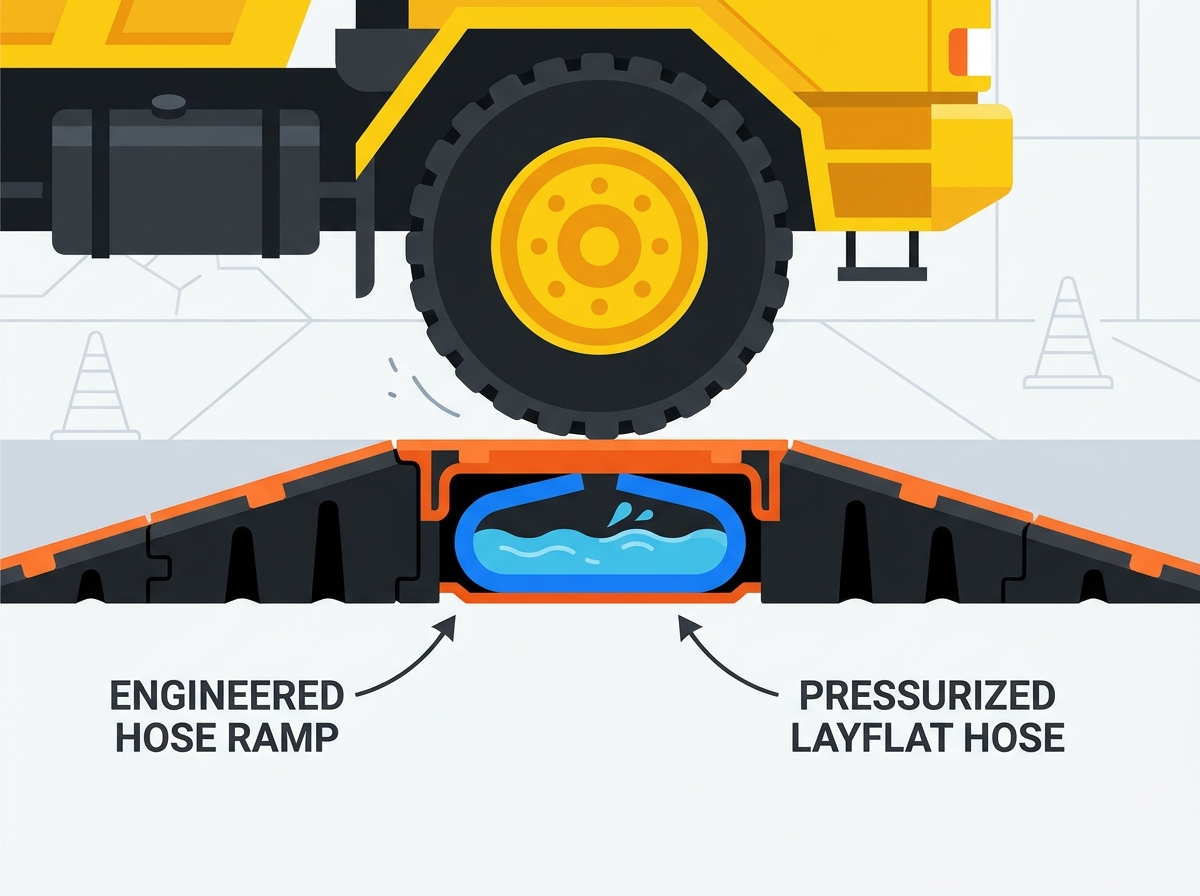
You have multiple effective strategies available to secure your transfer lines. Industry professionals rely on three core solutions. Each approach fits specific environmental conditions and traffic volumes.
Modular polyurethane and rubber ramp systems represent the most popular solution. Manufacturers design these ramps with integrated protective channels. You lay the hose inside the channel. The ramp then absorbs the entire weight of the passing vehicle. The tire never touches the pressurized line.
These bridges offer excellent flexibility. Workers can connect multiple modular sections together. This allows you to cover wide roadways easily. High-traffic temporary access roads represent the primary use case here. Construction teams require rapid deployment. You can install a modular ramp system in minutes. When the project moves, you simply pick them up and relocate them.
Safety ends provide a slightly different approach. These are specialized sloped transitions. You typically install them on rigid bypass pipes or specific reinforced hose profiles. They create a smooth, gradual incline for vehicle tires. This allows cars and trucks to traverse the obstacle smoothly.
These attachments eliminate harsh bumps. They reduce the dynamic impact transferred to the fluid line. Semi-permanent crossings represent the ideal use case. You might use them in municipal bypass projects. They work perfectly when trenching isn't viable due to underground utilities. They offer excellent stability for medium-term deployments.
Sometimes surface protection cannot meet your operational demands. Trenching and culvert routing offer a robust alternative. You physically bury the line beneath the crossing surface. Workers dig a shallow trench across the road. They place the line inside a protective steel culvert. Finally, they cover the trench.
This method involves distinct operational trade-offs. Trenching requires heavy equipment and significant labor. You permanently alter the road surface. However, it offers absolute protection from vehicle traffic. Long-term projects represent the best use case. Sites handling heavy, continuous machinery traffic benefit immensely. Surface ramps often pose clearance issues for specialized low-riding equipment. Trenching completely removes the obstacle from the driving surface.
Choosing the correct protection system requires careful evaluation. You must analyze your specific site conditions. A one-size-fits-all approach inevitably leads to equipment failure. Follow this procurement framework to ensure maximum safety.
You must rigorously define your weight capacity requirements. A massive difference exists between passenger vehicle loads and heavy industrial equipment. A standard pickup truck exerts relatively low axle weight. An articulated dump truck exerts extreme downward force.
You must match the ramp’s dynamic load-bearing capacity to your heaviest potential site vehicle. Never estimate this number. Check the manufacturer specifications for every machine entering your site. Remember to account for fully loaded weights. A water truck weighs significantly more when full. Selecting a ramp rated below your maximum axle weight guarantees destruction. The ramp will crush, and your line will burst.
Proper channel fit determines the success of your installation. You must size the protection channel perfectly. The channel must accommodate the exact diameter of your layflat water transfer hose while it operates under full pressure.
Both oversized and undersized channels introduce severe risks. Oversized channels allow the line to shift laterally. The hose wriggles back and forth as vehicles pass over. This constant movement causes dangerous friction against the ramp walls. Conversely, undersized channels cause severe pinching. The ramp cannot close properly over the line. The top of the channel will cut into the synthetic jacket. You must measure the outer diameter carefully. Leave just enough clearance to prevent restriction.
The manufacturing material dictates both durability and field performance. You must compare the three dominant material options available today.
Material Comparison for Crossing Systems
| Material Type | Weight Capacity | Deployment Effort | Traction Quality |
|---|---|---|---|
| High-Density Polyurethane | Very High | Low (Lightweight) | Moderate |
| Vulcanized Rubber | High | High (Heavy) | Excellent |
| Steel Composites | Extreme | Very High (Machinery Needed) | Moderate |
High-density polyurethane dominates the temporary deployment market. It remains incredibly lightweight. One worker can carry a section easily. It boasts high load ratings and excellent chemical resistance. Vulcanized rubber offers distinct advantages for permanent installations. It provides superior surface grip. Vehicles maintain better traction in wet conditions. However, rubber ramps are heavy and difficult to deploy quickly. Steel composites handle extreme environments. You need them for tracked excavators. However, they require forklifts for installation.
Hose crossings alter normal traffic patterns. Therefore, they fall strictly under federal regulatory frameworks. The Federal Highway Administration (FHWA) dictates these rules. Specifically, hose crossings fall under Temporary Traffic Control (TTC) guidelines.
You will find these exact specifications in MUTCD Part 6. Site planners must align all crossing infrastructure with these rules. Ignoring MUTCD guidelines opens you to massive legal liability. If an accident occurs at your crossing, investigators will check for MUTCD compliance immediately. You must treat a hose crossing exactly like a temporary construction speed bump.
You cannot simply place a ramp on the road and walk away. You must provide adequate advance warning to approaching drivers. Drivers need time to decelerate safely. Striking a ramp at high speeds will launch a passenger vehicle into the air.
You must deploy specific traffic control devices to precede the crossing:
Proper placement guarantees safe navigation. You must ensure the crossing sits in highly visible areas. Never place a ramp just over the crest of a hill. Drivers cannot see the obstacle in time to brake.
Avoid blind corners entirely. Vehicles navigating a turn cannot react to a sudden ramp in their path. Avoid steep gradients as well. Downhill slopes drastically increase braking distance. Heavy trucks sliding down a gradient will destroy your ramp system upon impact. Measure your sightlines carefully. Guarantee approaching drivers have a clear view for several hundred feet.
Field deployment requires meticulous attention to detail. First, you must evaluate the ground surface. Ramps must deploy on flat, stable surfaces. You must sweep the area completely. The surface must remain debris-free.
Rocks or gravel trapped under the ramp will damage the road surface. More importantly, uneven ground prevents the ramp from sitting flush. A rocking ramp will eventually snap under heavy loads. You must also implement proper anchoring mechanisms. Ramps experience immense lateral force during heavy vehicle braking. Unanchored ramps will migrate down the road. Use steel stakes for dirt or gravel surfaces. Utilize interlocking dog-bone connectors for asphalt. These connectors bind modular sections into one solid, immovable block.
Correct positioning prevents mechanical stress. Never pull the layflat line completely taut through the channel. You must leave appropriate slack on both sides of the crossing. Minor shifting is inevitable during heavy traffic operations.
The ramp will move slightly over time. If the line remains too tight, this movement transfers directly to your couplings. The stress will rip the fittings right off the hose. Providing a gentle curve of slack accommodates this shifting effortlessly. Ensure the line enters the channel perfectly straight. Sharp angles at the entry point will chafe the jacket against the ramp edge.
Deployment does not end your responsibility. You must establish a strict protocol for daily visual checks. Crossing systems endure brutal conditions. They require constant monitoring to ensure ongoing safety.
Designate a specific safety officer for this task. They must inspect the crossing system every morning. Look closely for hairline cracking in polyurethane ramps. Check for connector separation between modular units. Most importantly, inspect the hose jacket for wear. Look for fraying fibers where the line exits the channel. If you spot any damage, halt traffic immediately. Replace the compromised component before resuming operations.
Protecting your fluid transfer lines requires proactive planning. Relying on vehicle ground clearance to bypass an active line is a dangerous false economy. It directly invites critical failure, expensive downtime, and massive legal liability. Engineered crossing protections form the foundation of safe site management.
A: No. Even when unpressurized, the weight of a vehicle will crush the synthetic fibers inside the jacket. This causes unseen structural damage. The weakened fibers will eventually lead to a catastrophic failure once the line is pressurized again.
A: Generally, vehicles should maintain a speed of 5 to 10 mph. Speed drastically increases the dynamic weight impact on the bridge. Hitting the ramp too fast also increases the risk of ramp displacement and loss of vehicle control.
A: Measure the hose's outer diameter only when it is fully pressurized. Select a ramp channel that offers a minimum of 0.5 inches of clearance. This specific gap prevents dangerous pinching while keeping the line secure.
A: Yes. Tracked machinery like excavators and dozers exert massive shear forces. Standard rubber or polyurethane ramps may be shredded by the steel tracks. Heavy-duty industrial steel bridges are strictly required for tracked equipment.